
Ducati’s “Knight and Steed” Livery for Mugello, Distillery Moves Into Harley HQ

These days, it don’t take much to open the news and grimace, which is why shiny stuff in the Powersports industry is becoming an increasingly attractive read; today, the weekly offerings include the following: 

Harley-Davidson has given 73,000 square feet of their headquarters building over to a distillery. 
Honda is getting ready to give us their CRF300F!
Both The National Powersports Dealer Association (NPDA) and Powersports Rep Association (PRA) are partnering up to increase ease of access and communications between dealer, rep and vendors.
Kove has given us a very nice 450RR to loook at; do you think they will release the inline-four to American shores?
Ducati has gone full Italian Renaissance with a fresh new livery scheme for Team Lenovo and their bikes. 

Let’s start with Harley’s new roommate, shall we?

Harley-Davidson HQ Makes Room for Distillery

A view of the Central Standard Craft Distillery’s new location in the Harley-Davidson headquarters. Media sourced from the Central Standard Craft Distillery.

Central Standard Craft Distillery to Take Up 73,000 Square Feet of HD Floor

Harley’s not had the easiest time of things, and while we weren’t even going to mention the way that their CEO, Jochen Seitz, stepped down after his contracted years were up. 

Financially, it is safe to say that Harley-Davidson is no longer making an easy surplus from its total winnings, as evidenced by the following gatherings about the ‘net: 

Global motorcycle shipments were down 17% in 2024 compared to 2023, while HDMC revenue was down 15%. (via RideApart).
Global retail sales of new motorcycles were down 7% for the full year 2024, with Q4 alone seeing a 15% decline globally and a 13% decline in North America (Via Harley-Davidson).
Q1 2025 consolidated revenue fell 23% year-over-year, and global retail sales dropped 21%, with North America declining 24% (Via Alnvest, May 1, 2025).

Whether the above is the catalyst for Harley’s new move to find a cool roomie for their headquarters is left to be seen, but we’re assuming it’s got something to do with it. 

A view of the Central Standard Craft Distillery’s new location in the Harley-Davidson headquarters. Media sourced from the Central Standard Craft Distillery.

According to RideApart, Central Standard Craft Distillery has purchased a substantial 73,000 square-foot section of Harley-Davidson’s historic main campus just outside of Milwaukee, with intentions to open their doors next Q3. The building was previously purchased along with land for a $20 million park – and, back in 2024, Jochen Zeitz told everyone that Harley-Davidson was “happy to have its campus as a community anchor,” imparting the following at the location’s ribbon-cutting ceremony:

“We could not be more proud to be part of the Near West Side, to be part of the community here in Milwaukee. A lot has changed in 120 years, but there’s one that hasn’t, that won’t change ever. And that is [that] Juneau Avenue is our home.”

– Jochen Zeitz, previous CEO, Harley-Davidson (Urban Milwaukee)

As for Central Standard Craft Distillery, they’re naturally quite pleased to have the space to themselves, having been quoted to have mentioned that the space will allow the distillery to grow 20 times their current size – not a small feat, nor a bad one, as evidenced by the Co-Founder’s comments below: 

“With this purchase, we’re excited to deepen our roots in the city we love, and to show our commitment and investment in the Milwaukee community.”

– Pat McQuillan, Co-Founder and President, Central Standard Craft Distillery (RideApart)

We’re super happy for both parties and will be keeping an eye on how Harley’s “next phase of investment at Juneau Avenue” plays out in the coming years. 

For a full deep dive into Harley-Davidson’s HQ movement, be sure to check out the following article on Urban Milwaukee: 

Harley-Davidson Reveals Plans for Future of Corporate Campus

Fast Filings: Honda Preps to Release CRF300F to America

Media sourced from Rust Sports.

Air-Cooled Model Slotted for 2026

Our beloved Big Red is officially readying to give us a new air-cooled machine!

Christened the 2026 CRF300F, this new trail bike recently showed up in filings from the California Air Resources Board (CARB), proving that an arrival to US markets is confirmed and now simply a matter of waiting until the unit is debuted. 

Based on these filings – sourced by the incomparable Dennis Chung at Motorcycle.com – we know the following: 

Honda’s upcoming CRF300F is fuelled by a 293cc fuel-injected, air-cooled single-cylinder engine.
Power is expected to be around 24 horsepower @ 7,500 rpm and 20 lb-ft. of torque @ 5,750 rpm.
The CRF300F will be paired to a six-speed gearbox with obligatories including a linked rear shock, a telescopic fork, and a single petal-style front brake disc.
Suggestions within the paperwork guess at the appearance of an oil cooler and a new aluminum swingarm.
Bodywork will remain classic to Honda’s CRF line. 

As for it’s placement within the industry, Honda’s incubating CRF300F will likely slide in right around where Honda currently shows off their lovely – but as yet not updated – CRF250F. 

Guessing the CRF300F’s debut is a bit tricky; Chung presumes that the machine will likely debut sometime this summer, while we wonder what Honda has coming for their attendance at EICMA. Thus far, we’ve seen the return of the CBR600RR to Big Red’s European lineup after a six-year hiatus (2023), and the arrival of a world-first high-performance V3 engine coupled with new EV models (2024).

Only time will tell!

For a full dive into the details of the incoming 2026 Honda CRF300F, be sure to head over to Motorcycle.com: 

New 2026 Honda CRF300F Coming to America

Industry Insider: PRA and NPDA Partner Up for the Ultimate Dealer-Vendor Connection

The PRA and NDPA. Media sourced from PRA.

“A Rising Tide Floats All Boats”

This article’s about to feature more acronyms than leather vests at Sturgis, so I’ll leave the following below: 

PRA = The Powersports Rep Association 

NPDA = National Powersports Dealer Association

For those of you unfamiliar with either of these organizations, think of the the Powersports Rep Association (PRA) like a helpful group specifically for the people who sell motorcycles, ATVs, side-by-sides, and all the gear to the dealerships. These guys are the ones that help our reps be awesome at their jobs and build trust across the whole powersports world. 

Then we have the NPDA. These gentlefolk are present to support, educate, and speak for powersports dealerships, helping them grow and making the whole industry more efficient financially beneficial for both the dealer and the rider looking to get a new machine into the garage. 

You can see why these two collaborating together is such a power move, yes? 

Excellent, and big congrats to both the PRA and the NPDA!

According to CycleNews, the partnership will allow talks between the PRA and NPDA; in sharing information about their processes and training methods, the customer’s experience will be that much better at a dealership because the quality of the service center’s… well, service… will be at an all-time high. 

Brilliant. 

Naturally, both sides of the deal are more than excited to see what this partnership brings about: 

“By advocating for a healthy and personal partnership between the dealer, rep and vendor, we will only strengthen our business relationship resulting in a more professional profitable powersports industry as a whole. We are better together.”

– Bob Kee, Chairman, the National Powersports Dealer Association (NPDA) (CycleNews)

“An open communication pathway directly from rep/brand to the dealer network is something this industry has been missing for some time. We vow to make the effort in this collaboration to provide premier certified sales professionals in the powersports industry that will align with the Dealerships’ values.”

– Industry Vet, Tim Calhoun, the he Powersports Rep Association (PRA) (CycleNews)

The wBW team is so incredibly excited for this partnership; more than ever before, manufacturers are in need of solid processes and services to help connect to the customer, especially considering the volatility of our current markets and the changes happening within our good Powersports industry. We will always support moves toward a unified and profitable future for riders countrywide.

For more details on this strategic new collaboration, be sure to read the full report on CycleNews:

PRA Partners With NPDA

Kove Refreshes 450RR for New Model Year

A view of Kove Moto’s 450RR. Media sourced from Kove Moto.

Panigale-Esque Looker Could Be Headed for American Markets

Want a Ducati Panigale, but you’re really just tied to the aesthetics? Kove might be able to help with that… that is, if they release their new inline-four beastie to US markets. 

According to a recent report from CycleWorld, Kove’s 450RR has appeared in type approval documents that prove Kove has a larger-capacity engine in mind for their entry-level supersport. We’re told that the cubic capacity will likely be somewhere between 600cc and 800cc, based on the 450RR’s design, and that the official result of all this hullaballoo will be debuted next year, sometime in 2026.

Anytime a bike brand from the Far Eastern Hemisphere makes a supersport bike and uprates the thing to a larger capacity, there is huge potential for the machine to enter markets with bigger bikes. In this case, our fingers are crossed for the Americas, as it would be fantastic to have the competitor to Kawasaki’s ZX-4RR on the same track.

On to the bike’s personality. Perks of owning one of these bad boys include Bologna-style winglets, hooded headlights, and a fully adjustable suspension set complete with radial-mount four-piston calipers. The whole thing is set to buzz about around 70 hp @ 13,000 rpm with 28.8 lb.-ft. of yank available @ 9000 rpm.

We can’t wait for this bike to be debuted so that we can see if there’s potential to bring a 450RR to American soil. 

For a detailed look at the Kove 450RR update and what it could mean for Western markets, be sure to check out the full article on CycleWorld: 

Updated Kove 450RR

Knights and Steeds: Ducati Decks Out MotoGP Lenovo Team in Italian Renaissance Leathers

A view of the “steeds” belonging to Francesco Bagnaia (#63) and Marc Márquez (#93) for Mugello. Media sourced from Ducati.

New Livery Inspires “Knights and Steeds” for Mugello

There’s one thing I haven’t really seen in the Powersports industry – like, ever – and that’s a collection that marries the concepts of motorcycles being similar to horses. In fairness, while both sport reasonably slim silhouettes on pavement and both show off horsepower (snort), the industries are nowhere near each other in similarity.

Perhaps this is why Ducati took such a heavy lean toward the “Italian Renaissance” when they premiered their brand-new livery set for their Ducati Lenovo MotoGP team. 

According to coverage from Ducati’s press release, our favorite Bologna-based bike brand has presented a truly tasty set of leathers for the Italian Grand Prix at Mugello. This ultra-special  livery celebrates the very essence of chivalry in a bygone era, with both Francesco Bagnaia (#63) and Marc Márquez (#93) transformed into what the press release calls “modern-day knights.”

Ducati’s move behind this collection is twofold: 

Ducati has a tendency of expressing themselves at their country’s grid effort at Mugello, with 2024’s “Azzurro” homage coming to mind. 
Merging technology and beauty is Ducati’s very reason for existing, and they feel the Renaissance is the perfect era to embody both those qualities in their ethos.

But back to the collection. 

Marc Márquez (#93) in their new Mugello livery. Media sourced from Ducati.

We’re told that this livery set was the responsibility – and pleasure – of renowned designer Aldo Drudi and historian Marcello Simonetta, who in turn pulled from two iconic Renaissance figures – Leonardo da Vinci, the genius, and Niccolò Machiavelli, the macabre “thinker” – by reinterpreting Leonardo’s famous “Ancient Captain” drawing by showing off a lion and a fox. This harkens the teaching’s of Machiavelli’s most prolific work, “The Prince”: to win, one needs both the strength of the lion and the cunning of the fox!

How very poetic, how utterly Ducati.

To see more details and the stunning imagery of this unique Renaissance-inspired livery, be sure to check out Ducati’s official press release: 

Renaissance genius and Ducati vision come together in a unique tribute for the Italian Grand Prix

 

These days, it don’t take much to open the news and grimace, which is why shiny stuff in the Powersports industry is becoming an increasingly attractive read; today, the weekly offerings include the following: 

Harley-Davidson has given 73,000 square feet of their headquarters building over to a distillery. 
Honda is getting ready to give us their CRF300F!
Both The National Powersports Dealer Association (NPDA) and Powersports Rep Association (PRA) are partnering up to increase ease of access and communications between dealer, rep and vendors.
Kove has given us a very nice 450RR to loook at; do you think they will release the inline-four to American shores?
Ducati has gone full Italian Renaissance with a fresh new livery scheme for Team Lenovo and their bikes. 

Let’s start with Harley’s new roommate, shall we?

Harley-Davidson HQ Makes Room for Distillery

A view of the Central Standard Craft Distillery’s new location in the Harley-Davidson headquarters. Media sourced from the Central Standard Craft Distillery.

Central Standard Craft Distillery to Take Up 73,000 Square Feet of HD Floor

Harley’s not had the easiest time of things, and while we weren’t even going to mention the way that their CEO, Jochen Seitz, stepped down after his contracted years were up. 

Financially, it is safe to say that Harley-Davidson is no longer making an easy surplus from its total winnings, as evidenced by the following gatherings about the ‘net: 

Global motorcycle shipments were down 17% in 2024 compared to 2023, while HDMC revenue was down 15%. (via RideApart).
Global retail sales of new motorcycles were down 7% for the full year 2024, with Q4 alone seeing a 15% decline globally and a 13% decline in North America (Via Harley-Davidson).
Q1 2025 consolidated revenue fell 23% year-over-year, and global retail sales dropped 21%, with North America declining 24% (Via Alnvest, May 1, 2025).

Whether the above is the catalyst for Harley’s new move to find a cool roomie for their headquarters is left to be seen, but we’re assuming it’s got something to do with it. 

A view of the Central Standard Craft Distillery’s new location in the Harley-Davidson headquarters. Media sourced from the Central Standard Craft Distillery.

According to RideApart, Central Standard Craft Distillery has purchased a substantial 73,000 square-foot section of Harley-Davidson’s historic main campus just outside of Milwaukee, with intentions to open their doors next Q3. The building was previously purchased along with land for a $20 million park – and, back in 2024, Jochen Zeitz told everyone that Harley-Davidson was “happy to have its campus as a community anchor,” imparting the following at the location’s ribbon-cutting ceremony:

“We could not be more proud to be part of the Near West Side, to be part of the community here in Milwaukee. A lot has changed in 120 years, but there’s one that hasn’t, that won’t change ever. And that is [that] Juneau Avenue is our home.”

– Jochen Zeitz, previous CEO, Harley-Davidson (Urban Milwaukee)

As for Central Standard Craft Distillery, they’re naturally quite pleased to have the space to themselves, having been quoted to have mentioned that the space will allow the distillery to grow 20 times their current size – not a small feat, nor a bad one, as evidenced by the Co-Founder’s comments below: 

“With this purchase, we’re excited to deepen our roots in the city we love, and to show our commitment and investment in the Milwaukee community.”

– Pat McQuillan, Co-Founder and President, Central Standard Craft Distillery (RideApart)

We’re super happy for both parties and will be keeping an eye on how Harley’s “next phase of investment at Juneau Avenue” plays out in the coming years. 

For a full deep dive into Harley-Davidson’s HQ movement, be sure to check out the following article on Urban Milwaukee: 

Harley-Davidson Reveals Plans for Future of Corporate Campus

Fast Filings: Honda Preps to Release CRF300F to America

Media sourced from Rust Sports.

Air-Cooled Model Slotted for 2026

Our beloved Big Red is officially readying to give us a new air-cooled machine!

Christened the 2026 CRF300F, this new trail bike recently showed up in filings from the California Air Resources Board (CARB), proving that an arrival to US markets is confirmed and now simply a matter of waiting until the unit is debuted. 

Based on these filings – sourced by the incomparable Dennis Chung at Motorcycle.com – we know the following: 

Honda’s upcoming CRF300F is fuelled by a 293cc fuel-injected, air-cooled single-cylinder engine.
Power is expected to be around 24 horsepower @ 7,500 rpm and 20 lb-ft. of torque @ 5,750 rpm.
The CRF300F will be paired to a six-speed gearbox with obligatories including a linked rear shock, a telescopic fork, and a single petal-style front brake disc.
Suggestions within the paperwork guess at the appearance of an oil cooler and a new aluminum swingarm.
Bodywork will remain classic to Honda’s CRF line. 

As for it’s placement within the industry, Honda’s incubating CRF300F will likely slide in right around where Honda currently shows off their lovely – but as yet not updated – CRF250F. 

Guessing the CRF300F’s debut is a bit tricky; Chung presumes that the machine will likely debut sometime this summer, while we wonder what Honda has coming for their attendance at EICMA. Thus far, we’ve seen the return of the CBR600RR to Big Red’s European lineup after a six-year hiatus (2023), and the arrival of a world-first high-performance V3 engine coupled with new EV models (2024).

Only time will tell!

For a full dive into the details of the incoming 2026 Honda CRF300F, be sure to head over to Motorcycle.com: 

New 2026 Honda CRF300F Coming to America

Industry Insider: PRA and NPDA Partner Up for the Ultimate Dealer-Vendor Connection

The PRA and NDPA. Media sourced from PRA.

“A Rising Tide Floats All Boats”

This article’s about to feature more acronyms than leather vests at Sturgis, so I’ll leave the following below: 

PRA = The Powersports Rep Association 

NPDA = National Powersports Dealer Association

For those of you unfamiliar with either of these organizations, think of the the Powersports Rep Association (PRA) like a helpful group specifically for the people who sell motorcycles, ATVs, side-by-sides, and all the gear to the dealerships. These guys are the ones that help our reps be awesome at their jobs and build trust across the whole powersports world. 

Then we have the NPDA. These gentlefolk are present to support, educate, and speak for powersports dealerships, helping them grow and making the whole industry more efficient financially beneficial for both the dealer and the rider looking to get a new machine into the garage. 

You can see why these two collaborating together is such a power move, yes? 

Excellent, and big congrats to both the PRA and the NPDA!

According to CycleNews, the partnership will allow talks between the PRA and NPDA; in sharing information about their processes and training methods, the customer’s experience will be that much better at a dealership because the quality of the service center’s… well, service… will be at an all-time high. 

Brilliant. 

Naturally, both sides of the deal are more than excited to see what this partnership brings about: 

“By advocating for a healthy and personal partnership between the dealer, rep and vendor, we will only strengthen our business relationship resulting in a more professional profitable powersports industry as a whole. We are better together.”

– Bob Kee, Chairman, the National Powersports Dealer Association (NPDA) (CycleNews)

“An open communication pathway directly from rep/brand to the dealer network is something this industry has been missing for some time. We vow to make the effort in this collaboration to provide premier certified sales professionals in the powersports industry that will align with the Dealerships’ values.”

– Industry Vet, Tim Calhoun, the he Powersports Rep Association (PRA) (CycleNews)

The wBW team is so incredibly excited for this partnership; more than ever before, manufacturers are in need of solid processes and services to help connect to the customer, especially considering the volatility of our current markets and the changes happening within our good Powersports industry. We will always support moves toward a unified and profitable future for riders countrywide.

For more details on this strategic new collaboration, be sure to read the full report on CycleNews:

PRA Partners With NPDA

Kove Refreshes 450RR for New Model Year

A view of Kove Moto’s 450RR. Media sourced from Kove Moto.

Panigale-Esque Looker Could Be Headed for American Markets

Want a Ducati Panigale, but you’re really just tied to the aesthetics? Kove might be able to help with that… that is, if they release their new inline-four beastie to US markets. 

According to a recent report from CycleWorld, Kove’s 450RR has appeared in type approval documents that prove Kove has a larger-capacity engine in mind for their entry-level supersport. We’re told that the cubic capacity will likely be somewhere between 600cc and 800cc, based on the 450RR’s design, and that the official result of all this hullaballoo will be debuted next year, sometime in 2026.

Anytime a bike brand from the Far Eastern Hemisphere makes a supersport bike and uprates the thing to a larger capacity, there is huge potential for the machine to enter markets with bigger bikes. In this case, our fingers are crossed for the Americas, as it would be fantastic to have the competitor to Kawasaki’s ZX-4RR on the same track.

On to the bike’s personality. Perks of owning one of these bad boys include Bologna-style winglets, hooded headlights, and a fully adjustable suspension set complete with radial-mount four-piston calipers. The whole thing is set to buzz about around 70 hp @ 13,000 rpm with 28.8 lb.-ft. of yank available @ 9000 rpm.

We can’t wait for this bike to be debuted so that we can see if there’s potential to bring a 450RR to American soil. 

For a detailed look at the Kove 450RR update and what it could mean for Western markets, be sure to check out the full article on CycleWorld: 

Updated Kove 450RR

Knights and Steeds: Ducati Decks Out MotoGP Lenovo Team in Italian Renaissance Leathers

A view of the “steeds” belonging to Francesco Bagnaia (#63) and Marc Márquez (#93) for Mugello. Media sourced from Ducati.

New Livery Inspires “Knights and Steeds” for Mugello

There’s one thing I haven’t really seen in the Powersports industry – like, ever – and that’s a collection that marries the concepts of motorcycles being similar to horses. In fairness, while both sport reasonably slim silhouettes on pavement and both show off horsepower (snort), the industries are nowhere near each other in similarity.

Perhaps this is why Ducati took such a heavy lean toward the “Italian Renaissance” when they premiered their brand-new livery set for their Ducati Lenovo MotoGP team. 

According to coverage from Ducati’s press release, our favorite Bologna-based bike brand has presented a truly tasty set of leathers for the Italian Grand Prix at Mugello. This ultra-special  livery celebrates the very essence of chivalry in a bygone era, with both Francesco Bagnaia (#63) and Marc Márquez (#93) transformed into what the press release calls “modern-day knights.”

Ducati’s move behind this collection is twofold: 

Ducati has a tendency of expressing themselves at their country’s grid effort at Mugello, with 2024’s “Azzurro” homage coming to mind. 
Merging technology and beauty is Ducati’s very reason for existing, and they feel the Renaissance is the perfect era to embody both those qualities in their ethos.

But back to the collection. 

Marc Márquez (#93) in their new Mugello livery. Media sourced from Ducati.

We’re told that this livery set was the responsibility – and pleasure – of renowned designer Aldo Drudi and historian Marcello Simonetta, who in turn pulled from two iconic Renaissance figures – Leonardo da Vinci, the genius, and Niccolò Machiavelli, the macabre “thinker” – by reinterpreting Leonardo’s famous “Ancient Captain” drawing by showing off a lion and a fox. This harkens the teaching’s of Machiavelli’s most prolific work, “The Prince”: to win, one needs both the strength of the lion and the cunning of the fox!

How very poetic, how utterly Ducati.

To see more details and the stunning imagery of this unique Renaissance-inspired livery, be sure to check out Ducati’s official press release: 

Renaissance genius and Ducati vision come together in a unique tribute for the Italian Grand Prix
 

photo_2025-07-10_11-55-49

Hands-On Review: Richa Infinity 3 Pro Jacket

The Richa Infinity 3 Pro is a multi-season textile motorcycle adventure touring jacket designed for riders looking for a balance between affordability, comfort, and protection. Priced at around $465, it features a laminated waterproof membrane, thermal liner, CE AA abrasion rating, and D3O CE Level 1 armor in the shoulders and elbows.

It sits at the top of Richa’s Infinity line and offers excellent build quality with thoughtful features.

Review Summary

  • Waterproofing: AquaShell LTZ membrane integrated into the jacket’s outer shell

  • Abrasion Protection: CE AA rated Cordura + Superfabric at impact zones

  • Impact Protection: D3O CE Level 1 armor in shoulders and elbows

  • Comfort: Neoprene collar, detachable thermal liner, ergonomic design

  • Visibility: Hi-viz colorway with extensive reflective elements

  • Ventilation: Chest and forearm vents + back exhausts

Downsides:

  • No back protector included

  • Only CE Level 1 armor

  • Limited sizing options—no tall/short or women’s sizes

  • Type B armor would be better for larger sizes

Jacket Features

  • Abrasion-resistant Cordura outer shell

  • Superfabric reinforcements in high-impact zones

  • Laminated waterproof Aquashell LTZ membrane

  • D3O CE Level 1 shoulder and elbow armor

  • Large front vent panels with Fidlock closures

  • Thermal liner with standalone wearability

  • Adjustable waist, arms, collar, and wrists

  • 7 outer pockets + 4 liner pockets

  • Hi-visibility and reflective elements throughout

Build Quality & Materials

  • Outer Shell: 100% Polyester (Cordura + Superfabric)

  • Membrane: 100% Polyester (Aquashell LTZ)

  • Lining: 100% Polyester mesh for airflow

The materials feel durable and well-assembled, with smooth zippers, solid stitching, and robust hardware throughout.

Fit & Comfort

The jacket fits true to the Richa sizing chart. Riders with longer torsos may find the length slightly short. It features:

  • Curved arms for comfort in riding position

  • Ample sleeve length

  • Adjustable elements to fine-tune fit

  • Neoprene collar edge to prevent chafing

The included thermal liner is warm, easy to remove, and can be worn as a standalone jacket off the bike.

Ventilation & Breathability

Ventilation is good—but not great. Laminated waterproofing limits airflow compared to jackets with removable liners.

Ventilation Features:

  • Chest vents with Fidlock magnetic system

  • Forearm intake vents

  • Rear exhaust vents behind storm flaps

For hot summer days, a jacket like the Infinity 2 Adventure, which features larger mesh panels and more venting, would outperform it.

Protection

  • CE AA abrasion rating

  • D3O CE Level 1 armor in shoulders and elbows

  • Pockets for optional back and chest protectors

Armor Certification Details:

  • Shoulder (EN 1621-1:2012, Type A, Level 1)

  • Elbow (EN 1621-1:2012, Type A, Level 1)

While protection is solid, the jacket could benefit from CE Level 2 armor and Type B (larger coverage) in bigger sizes. The lack of an included back protector is a notable omission at this price point.

Waterproofing

The Aquashell LTZ membrane performs very well in real-world rain testing. It kept the rider completely dry during light to moderate rainfall.

Make sure chest vents are securely closed in wet weather; rear exhaust vents are protected by storm flaps.

Visibility

The Black/Grey/Fluorescent Yellow colorway is highly visible during the day. The jacket includes extensive reflective trim in key zones (back, arms, chest, branding) for low-light conditions.

Color Options

  • Black/Grey/Fluorescent Yellow

  • Black/Grey

Sizing

Available in:
Men’s S, M, L, XL, 2XL, 3XL, 4XL, 5XL, 6XL

No tall, short, or women’s versions are offered.

Pros

  • Integrated AquaShell waterproof membrane

  • D3O Level 1 armor included

  • CE AA abrasion rating

  • Detachable thermal liner (wearable separately)

  • Excellent build quality and adjustability

  • Good visibility in all conditions

Cons

  • Back protector not included

  • Only Level 1 armor

  • No women’s or tall/short sizing

  • Type B armor would be ideal for larger sizes

Final Verdict

The Richa Infinity 3 Pro is a strong option for riders looking for an affordable, all-season adventure jacket with solid protection and waterproofing. While it lacks top-tier ventilation and higher-level armor, it delivers great value, comfort, and usability across a wide range of temperatures and weather.

If you ride in mixed conditions and want an integrated waterproof jacket with thoughtful features and solid performance, the Infinity 3 Pro is an excellent mid-range choice.

Klim K Forty 2 Stretch Denim Jeans Review

Klim aims to dominate the space between traditional streetwear and armored Kevlar-lined jeans with the K Forty 2 Stretch Denim. These straight-cut, casual-looking riding jeans are made from premium 13oz stretch denim and include nearly invisible D3O IP Ghost CE Level 1 armor in the hips and knees. They offer unmatched comfort and street style without compromising basic protection, making them a strong choice for everyday riders.

Pros

  • Discreet D3O IP Ghost armor (knees and hips) included

  • Exceptional comfort on and off the bike

  • Streetwear styling that blends in

  • Premium 13oz stretch denim and top-tier stitching

  • CE AA rating (EN 17092-3)

Cons

  • No “Tall” sizing options available

  • No Kevlar lining (relies solely on stretch denim for abrasion resistance)

  • Only two color choices

Overall Score: 4.4 / 5

Review Summary

  • Price: $279.99 USD

  • Colors: Indigo, Cobalt

  • Sizing: 30–40 waist; max 34″ inseam

  • D3O Ghost armor included (knees and hips)

  • CE AA certified (EN 17092-3)

  • No Kevlar liner

  • True-to-size fit for average-height riders

  • Comfortable enough for all-day wear

  • Ideal blend of casual style and functional riding gear

First Impressions

Out of the box, the jeans look and feel like high-end casual denim—nothing about them screams “motorcycle gear.” Even when worn, the D3O armor is virtually invisible and feather-light. The armor was already installed and blended in so well that it initially seemed missing. That subtle first impression carried through to every ride.

Street Style or Street Protection?

The K Forty 2 jeans genuinely resemble upscale casual or even dress jeans. Their straight-cut fit is modern and practical—better suited to riding than overly tapered cuts but still flattering.

They slot perfectly into a wardrobe without drawing attention. For riders who prefer gear that doesn’t look like gear, these jeans are spot-on.

Build quality is exceptional, with Klim’s signature attention to detail evident in the stitching, waistband, and flexibility of the denim. The only disappointment is the limited color palette: Cobalt (blue) and Indigo (darker blue). A black or grey option would have broadened appeal significantly.

Design & Quality: 95%

Sizing & Fit

These jeans fit true to size and are ideal for average-height riders. At 5’10”, the 32×32 size provided a perfect fit on and off the bike. However, the absence of tall sizing (no 36” inseam option) is a letdown for riders over 6’2”, who may find the jeans ride up when seated.

Size & Fit: 80%

Protection

Let’s be clear—these jeans prioritize comfort and stealth over extreme protection. The included D3O IP Ghost armor is incredibly slim, flexible, and almost weightless. It moves with you like a second skin, offering CE Level 1 impact protection without any bulk.

That said, abrasion protection is limited to the 13oz stretch denim—there’s no Kevlar or aramid layer. While the jeans are CE AA certified, they’re not built for high-speed or aggressive off-road riding. For urban and casual use, they strike a solid balance.

Protection: 75%

All-Day Comfort

Comfort is where the K Forty 2 jeans really shine. The stretch denim is breathable and moves effortlessly with your body. The D3O armor is so unobtrusive you’ll forget it’s there—until you need it.

These jeans feel like regular denim, and that’s precisely the point. Whether walking around town or riding for hours, the comfort remains consistent. They don’t overheat, at least not in mild-to-warm temperatures. For peak summer heat, mesh pants are still a better bet.

Comfort: 100%

Value for Money

At just under $280, the jeans sit in the mid-to-high range for armored denim. But considering the premium materials, CE AA certification, and included D3O Ghost armor, they offer real value. The lack of a Kevlar liner is a compromise, but one that makes sense if comfort is your top priority.

You’re paying for a riding jean that doesn’t feel like one—without sacrificing basic protection.

Value for Money: 90%

Final Verdict

The Klim K Forty 2 Stretch Denim Jeans are a perfect everyday riding companion for urban and light touring use. They’re stylish, low-profile, and supremely comfortable. While their protection levels won’t match full race-spec gear, they deliver excellent practicality for the real world.

If you want jeans you’ll actually want to wear—on and off the bike—these are an excellent choice.

Aircela Pulls Fuel Out of Thin Air, Norton Preps Four Projects for 2026

Aircela Pulls Fuel Out of Thin Air, Norton Preps Four Projects for 2026

This week, we’ve got some really exciting bits of news from all corners of our industry:

Ural’s punting out a “Ural Neo 500,” estimated to be their most affordable sidecar yet – and it’s coming to America!
Kawasaki’s facing a recall affecting the crankcase bolts on over 17,000 motorcycles, with an estimated 1% affected.
Norton is giving heavy-hitter vibes with six projects lined up for future debuts – four of which are slotted for 2026.
Aircela, a New York-based startup company, is working toward the production of a fuel generator that can make chemically identical synthetic fuel out of our air.

Let’s start with Ural’s new number, as we haven’t chatted about Ural in a while!

Ural’s New Sidecar is Coming to America!

A view of a Ural sidecar. Media sourced from Ural.

Neo 500 to be Ural’s Most Affordable Sidecar Yet

The last time that we covered Ural, the brand was moving from Russia to Kazakhstan due to the Russo-Ukraine war. Ural’s residual evolution has since carried a refreshing of their beloved, horizontally-opposed, 745cc air-cooled flat-twin heart (new camshaft, roller tappet and rocker arm mechanism with better alloying, casting, and tighter component tolerances) – and now, we can enjoy the brand’s continued up-and-ups here across the pond!

According to CycleWorld, America is getting a more budget-friendly sidecar.  Named the Neo 500, this sidecar continues to boast the brand’s storied history, which dates back as far as WW2.

We’re told that Ural’s Neo 500 celebrated a lovely debut on US soil in Ural’s Washington headquarters – a fitting thing, considering Ural has been US-based since 2002, with America currently being the company’s largest market.

But back to the Neo 500.

While production of Ural’s boxer-twin bikes is currently underway in Kazakhstan, this new Neo 500 will be manufactured in China by Yingang – an efficient choice for when companies don’t have enough internal manufacturing facilities to build an all-new, cost-effective product.

The Neo 500 doesn’t yet seem to be at the production-prototype stage, as CycleWorld tells us that the Ural 500 coming to America has yet to lock in on official specs (height, weight, componentry, etc). Since we’re getting a bike and and sidecar with Ural’s offerings, we know that the Neo500 will be less than Ural’s next model in line, currently going for $19,999 USD. Ben Purvis also estimates that the unit will be similar to the SUV500 II it’s based on, which carries a Zongshen-designed 446cc parallel-twin engine.

Power (of the bike, not the sidecar) is anticipated to be around 35hp, with a substantial 5.3-gallon fuel tank driving a purpose-built chassis with a leading-link front suspension system and further specs reminiscent of Ural’s existing 750cc boxer-twins.

The core aim for the Ural Neo 500 is rider-friendliness, as Ural is well aware that many of their future customers will be new to the sidecar world as a whole. Better still, we’re told that Ural’s aiming for this sidecar to enter US markets under $15,000 USD, which will be realized sometime mid-2026.

To get all the details on Ural Neo’s new affordable sidecar, be sure to check out the full article on CycleWorld:

Ural Neo 500 Coming To US

Total Recall: 17,792 Ninja ZX-6R Motorcycles Affected

A view of a Kawasaki ZX-6R. Media sourced from Kawasaki.

“Certain Vehicles May Lose Engine Power During Operation”

We try to post things that are more exciting than recalls around here – but every once and a while, a recall comes by that’s impossible to ignore.

If you are in possession of a MY2024- 2025 ZX636J/K (Ninja ZX-6R) Kawasaki revver, pay attention: Your bike could very well be on a new list – along with 17,791 others – labelled “DO NOT DRIVE.”

According to the NHTSA’s recent recall notice (posted here for y’all to have a gander), the affected vehicles also include the MY24 NINJA ZX-6R 40th Anniversary Edition ABS, MY24-25 Ninja ZX-6R ABS/KRT Edition ABS, and the Ninja ZX-6R/KRT Edition. The recall population covers all units produced from April 2023 through April 28, 2025, totalling 17,792 units.

Apparently, the problem is a bunch of over-torqued crankcase bolts:

“Certain vehicles may lose engine power during operation due to a seizure of the No. 5 metal crankshaft bushing [leading to certain vehicles]… losing engine power and increasing the chance of a crash”

– National Highway Traffic Safety Administration (NHTSA)

For this type of issue, we’re told that riders won’t receive any warning before this potentially severe issue arises, leading to the urgency of the recall (despite only an estimated 1% of the affected motorcycles being projected to manifest the problem).

We DO know that the letter from NHTSA has already made its way to Kawasaki HQ, though as of June 11, 2025, there is no known remedy for this issue, nor has Kawasaki yet provided a schedule for recall notifications to owners.

Bottom line, MY2024-2025 ZX636J/K (Ninja ZX-6R) Kawasaki riders are recommended not to ride until a proper repair has been completed and officially communicated by Kawasaki.

For full details on this recall and to check if your bike is affected, please refer directly to the official NHTSA safety recall report:

Part 573 Safety Recall Report 25V376

Norton Preps to Launch Four-Cylinder Superbike at EICMA

A view of a Norton Motorcycle. Media sourced from Norton.

Six Products in the Pipeline, Four of Which are Slotted for 2026

It’s high time Norton refreshed the golden years on which they sit, and what better way to do this than to capitalize on the new ownership by dropping a fresh new superbike at EICMA this year?

It’s been a rollercoaster five years for Norton, but the iconic British marque has been quietly rebuilding, and new model launches are on the horizon (along with – surprise, surprise – new movement toward international expansion).

According to CycleWorld, the Managing Director of India’s third-largest motorcycle maker – and The Norton Motorcycle Co. Limited’s new parent company – has confirmed that Norton will target France, Germany, Italy, and Spain by 2026 with an expansion that will include four new models planned for a 2026 debut. , spearheaded by a revised version of the V-4 superbike.

Venu detailed the upcoming product pipeline in as many words below:

“I think I have mentioned six products before, four of which will be available for the summer of 2026 in the four European markets of the UK plus France, Germany, Italy, and Spain (also, of course, in India)… [we will start] off with the launch of the four-cylinder superbike at EICMA and then… the remaining three products at EICMA … which will be available in the market early 2026.

They’re all in advanced stages of development.”

– Sudarshan Venu, Managing Director, TVS Motors (CycleWorld)

Currently, we are aware that Norton’s V4SV superbike doesn’t meet Euro 5+ type-approval rules, meaning that the Norton team will need to do some finagling for the soon-to-be-revised V-4 superbike, given we’re assuming it’ll carry those iconic 185 ponies. We also know Norton’s daddy is keen on smaller-displacement bikes that will soon fill out the 450cc segment of our good industry – and yes, it’s highly likely that at least one of these entry-level bikes will carry the same platform that BMW will be using for their F 450 GS.

To Venu, the blending of platforms is a clear example of what’s to come:

“I think we [first] did the single cylinder, the 310 family. Then came the EV, and now is the two-cylinder family, which BMW has shown their version [of] at last year’s EICMA. And you will see Norton and TVS versions using a similar platform in the coming months.

So that is where I think the relationship is headed.”

– Sudarshan Venu, Managing Director, TVS Motors (CycleWorld)

To be fair, Norton would have a decent machine to compete against the likes of Triumph’s Speed 400 and Scrambler 400 X, so we will be curious to see where TVS goes as they continue to march toward new project deadlines.

The future is looking bright for this historic British brand!

For all the in-depth details on Norton’s expansive future plans and new model pipeline, be sure to read the full report on CycleWorld:

Norton Planning Six New Models

Light ‘er Up: New Startup Pulls Fossil-Free Fuel from the Air

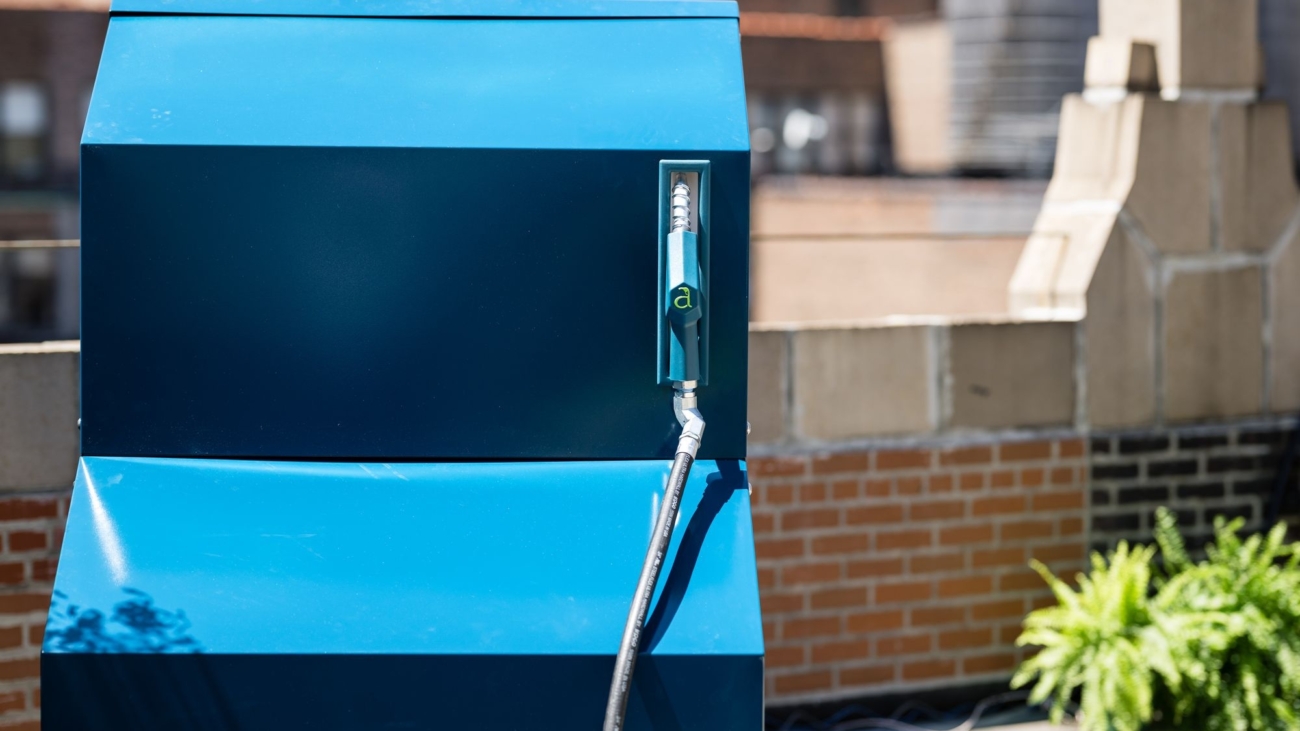
A view of the fuel generator that New-York-based startup Aircela is building for our fuel-minded industry. Media sourced from Aircela.

Meet the New York-Born Aircela Fuel Generator

I mean. We all love the idea that fuel could go from being a major contender in the weekly budget to something we can just pull out of thin air, right?

Well, we think New York-based startup Aircela must have been of a similar mind when they went ahead and created a generator that could produce genuine, pump-grade petrol using only air, water, and renewable electricity.

According to a report from Visordown, the fuel generated from Aircela’s invention is true, pump-grade gas, though the catch is that it’s a chemically identical synthetic ingredient boasting a rating of around RON 95+.

For those of you who aren’t as “fuel-nerdy” as some of my mates, those ratings position Aircela’s fuel on par with what we could consider to be “premium-grade fuel” in our industry.

“Because the fuel is made at a small scale using the methanol-to-gasoline (MTG) process, the team can fine-tune the synthesis and hydrotreating parameters to dial in specific octane levels.

A mid-range fuel typically measures around 89 to 90 AKI, and premium quality fuel is around 91 to 94 AKI.”

– Simon Hancocks (Visordown)

Since Aircela’s fuel is made by snatching CO2 and generating renewable energy, it’s effectively a carbon-neutral option that could give electric grids across the country the break they needed as infrastructure struggles to keep up with our EV-minded world.

Aircela isn’t just a garage dream, either. The company boasts support from big names like Maersk Growth and Ripple co-founder Chris Larsen, with commercial units.

On to the big question: Will production be a reality anytime soon?

A view of the fuel generator that New-York-based startup Aircela is building for our fuel-minded industry. Media sourced from Aircela.

The answer is… yes!  Units are expected to roll out by the fall of this year, though expanding after the initial launch is still an unknown for the company itself.

If Aircela’s claims hold true, the internal combustion engine might just have a much longer redline… and the future might still smell like fossils.

Or strawberries, or whatever this new stuff smells like.

For a full deep dive into Aircela’s groundbreaking fuel technology, be sure to check out the article on Visordown:

Fuel from Thin Air? New Tech Promises Fossil-Free Petrol for Motorcycles

*Media sourced from Ural Motorcycles, Kawasaki, Norton’s Facebook page, and Aircela*

The post Aircela Pulls Fuel Out of Thin Air, Norton Preps Four Projects for 2026 appeared first on webBikeWorld.

This week, we’ve got some really exciting bits of news from all corners of our industry:

Ural’s punting out a “Ural Neo 500,” estimated to be their most affordable sidecar yet – and it’s coming to America!
Kawasaki’s facing a recall affecting the crankcase bolts on over 17,000 motorcycles, with an estimated 1% affected.
Norton is giving heavy-hitter vibes with six projects lined up for future debuts – four of which are slotted for 2026.
Aircela, a New York-based startup company, is working toward the production of a fuel generator that can make chemically identical synthetic fuel out of our air.

Let’s start with Ural’s new number, as we haven’t chatted about Ural in a while!

Ural’s New Sidecar is Coming to America!

A view of a Ural sidecar. Media sourced from Ural.

Neo 500 to be Ural’s Most Affordable Sidecar Yet

The last time that we covered Ural, the brand was moving from Russia to Kazakhstan due to the Russo-Ukraine war. Ural’s residual evolution has since carried a refreshing of their beloved, horizontally-opposed, 745cc air-cooled flat-twin heart (new camshaft, roller tappet and rocker arm mechanism with better alloying, casting, and tighter component tolerances) – and now, we can enjoy the brand’s continued up-and-ups here across the pond!

According to CycleWorld, America is getting a more budget-friendly sidecar.  Named the Neo 500, this sidecar continues to boast the brand’s storied history, which dates back as far as WW2.

We’re told that Ural’s Neo 500 celebrated a lovely debut on US soil in Ural’s Washington headquarters – a fitting thing, considering Ural has been US-based since 2002, with America currently being the company’s largest market.

But back to the Neo 500.

While production of Ural’s boxer-twin bikes is currently underway in Kazakhstan, this new Neo 500 will be manufactured in China by Yingang – an efficient choice for when companies don’t have enough internal manufacturing facilities to build an all-new, cost-effective product.

The Neo 500 doesn’t yet seem to be at the production-prototype stage, as CycleWorld tells us that the Ural 500 coming to America has yet to lock in on official specs (height, weight, componentry, etc). Since we’re getting a bike and and sidecar with Ural’s offerings, we know that the Neo500 will be less than Ural’s next model in line, currently going for $19,999 USD. Ben Purvis also estimates that the unit will be similar to the SUV500 II it’s based on, which carries a Zongshen-designed 446cc parallel-twin engine.

Power (of the bike, not the sidecar) is anticipated to be around 35hp, with a substantial 5.3-gallon fuel tank driving a purpose-built chassis with a leading-link front suspension system and further specs reminiscent of Ural’s existing 750cc boxer-twins.

The core aim for the Ural Neo 500 is rider-friendliness, as Ural is well aware that many of their future customers will be new to the sidecar world as a whole. Better still, we’re told that Ural’s aiming for this sidecar to enter US markets under $15,000 USD, which will be realized sometime mid-2026.

To get all the details on Ural Neo’s new affordable sidecar, be sure to check out the full article on CycleWorld:

Ural Neo 500 Coming To US

Total Recall: 17,792 Ninja ZX-6R Motorcycles Affected

A view of a Kawasaki ZX-6R. Media sourced from Kawasaki.

“Certain Vehicles May Lose Engine Power During Operation”

We try to post things that are more exciting than recalls around here – but every once and a while, a recall comes by that’s impossible to ignore.

If you are in possession of a MY2024- 2025 ZX636J/K (Ninja ZX-6R) Kawasaki revver, pay attention: Your bike could very well be on a new list – along with 17,791 others – labelled “DO NOT DRIVE.”

According to the NHTSA’s recent recall notice (posted here for y’all to have a gander), the affected vehicles also include the MY24 NINJA ZX-6R 40th Anniversary Edition ABS, MY24-25 Ninja ZX-6R ABS/KRT Edition ABS, and the Ninja ZX-6R/KRT Edition. The recall population covers all units produced from April 2023 through April 28, 2025, totalling 17,792 units.

Apparently, the problem is a bunch of over-torqued crankcase bolts:

“Certain vehicles may lose engine power during operation due to a seizure of the No. 5 metal crankshaft bushing [leading to certain vehicles]… losing engine power and increasing the chance of a crash”

– National Highway Traffic Safety Administration (NHTSA)

For this type of issue, we’re told that riders won’t receive any warning before this potentially severe issue arises, leading to the urgency of the recall (despite only an estimated 1% of the affected motorcycles being projected to manifest the problem).

We DO know that the letter from NHTSA has already made its way to Kawasaki HQ, though as of June 11, 2025, there is no known remedy for this issue, nor has Kawasaki yet provided a schedule for recall notifications to owners.

Bottom line, MY2024-2025 ZX636J/K (Ninja ZX-6R) Kawasaki riders are recommended not to ride until a proper repair has been completed and officially communicated by Kawasaki.

For full details on this recall and to check if your bike is affected, please refer directly to the official NHTSA safety recall report:

Part 573 Safety Recall Report 25V376

Norton Preps to Launch Four-Cylinder Superbike at EICMA

A view of a Norton Motorcycle. Media sourced from Norton.

Six Products in the Pipeline, Four of Which are Slotted for 2026

It’s high time Norton refreshed the golden years on which they sit, and what better way to do this than to capitalize on the new ownership by dropping a fresh new superbike at EICMA this year? It’s been a rollercoaster five years for Norton, but the iconic British marque has been quietly rebuilding, and new model launches are on the horizon (along with – surprise, surprise – new movement toward international expansion).

According to CycleWorld, the Managing Director of India’s third-largest motorcycle maker – and The Norton Motorcycle Co. Limited’s new parent company – has confirmed that Norton will target France, Germany, Italy, and Spain by 2026 with an expansion that will include four new models planned for a 2026 debut. , spearheaded by a revised version of the V-4 superbike.

Venu detailed the upcoming product pipeline in as many words below:

“I think I have mentioned six products before, four of which will be available for the summer of 2026 in the four European markets of the UK plus France, Germany, Italy, and Spain (also, of course, in India)… [we will start] off with the launch of the four-cylinder superbike at EICMA and then… the remaining three products at EICMA … which will be available in the market early 2026.

They’re all in advanced stages of development.”

– Sudarshan Venu, Managing Director, TVS Motors (CycleWorld)

Currently, we are aware that Norton’s V4SV superbike doesn’t meet Euro 5+ type-approval rules, meaning that the Norton team will need to do some finagling for the soon-to-be-revised V-4 superbike, given we’re assuming it’ll carry those iconic 185 ponies. We also know Norton’s daddy is keen on smaller-displacement bikes that will soon fill out the 450cc segment of our good industry – and yes, it’s highly likely that at least one of these entry-level bikes will carry the same platform that BMW will be using for their F 450 GS.

To Venu, the blending of platforms is a clear example of what’s to come:

“I think we [first] did the single cylinder, the 310 family. Then came the EV, and now is the two-cylinder family, which BMW has shown their version [of] at last year’s EICMA. And you will see Norton and TVS versions using a similar platform in the coming months.

So that is where I think the relationship is headed.”

– Sudarshan Venu, Managing Director, TVS Motors (CycleWorld)

To be fair, Norton would have a decent machine to compete against the likes of Triumph’s Speed 400 and Scrambler 400 X, so we will be curious to see where TVS goes as they continue to march toward new project deadlines.

The future is looking bright for this historic British brand!

See also

For all the in-depth details on Norton’s expansive future plans and new model pipeline, be sure to read the full report on CycleWorld:

Norton Planning Six New Models

Light ‘er Up: New Startup Pulls Fossil-Free Fuel from the Air

A view of the fuel generator that New-York-based startup Aircela is building for our fuel-minded industry. Media sourced from Aircela.

Meet the New York-Born Aircela Fuel Generator

I mean. We all love the idea that fuel could go from being a major contender in the weekly budget to something we can just pull out of thin air, right?

Well, we think New York-based startup Aircela must have been of a similar mind when they went ahead and created a generator that could produce genuine, pump-grade petrol using only air, water, and renewable electricity.

According to a report from Visordown, the fuel generated from Aircela’s invention is true, pump-grade gas, though the catch is that it’s a chemically identical synthetic ingredient boasting a rating of around RON 95+.

For those of you who aren’t as “fuel-nerdy” as some of my mates, those ratings position Aircela’s fuel on par with what we could consider to be “premium-grade fuel” in our industry.

“Because the fuel is made at a small scale using the methanol-to-gasoline (MTG) process, the team can fine-tune the synthesis and hydrotreating parameters to dial in specific octane levels.

A mid-range fuel typically measures around 89 to 90 AKI, and premium quality fuel is around 91 to 94 AKI.”

– Simon Hancocks (Visordown)

Since Aircela’s fuel is made by snatching CO2 and generating renewable energy, it’s effectively a carbon-neutral option that could give electric grids across the country the break they needed as infrastructure struggles to keep up with our EV-minded world.

Aircela isn’t just a garage dream, either. The company boasts support from big names like Maersk Growth and Ripple co-founder Chris Larsen, with commercial units.

On to the big question: Will production be a reality anytime soon?

A view of the fuel generator that New-York-based startup Aircela is building for our fuel-minded industry. Media sourced from Aircela.

The answer is… yes!  Units are expected to roll out by the fall of this year, though expanding after the initial launch is still an unknown for the company itself.

If Aircela’s claims hold true, the internal combustion engine might just have a much longer redline… and the future might still smell like fossils.

Or strawberries, or whatever this new stuff smells like.

For a full deep dive into Aircela’s groundbreaking fuel technology, be sure to check out the article on Visordown:

Fuel from Thin Air? New Tech Promises Fossil-Free Petrol for Motorcycles

*Media sourced from Ural Motorcycles, Kawasaki, Norton’s Facebook page, and Aircela*

Hands-On Review: Richa Infinity 3 Pro Pants

Breakdown
The Richa Infinity 3 Pro Pants feature a thermal liner, D3O CE Level 1 knee and hip armor, and Cordura construction, providing a CE AA abrasion rating. They are available in an extensive range of sizes, including long and short variants. These are a great pair of adventure touring pants. I wish Richa would boost the protection level to level 2 and add larger-format armor in larger sizes.

Build Quality

Fit & Comfort

Waterproof

Protection

Value for Money

Pros
CE AA abrasion rating
Laminated Aquashell Waterproofing
Comfortable to wear
D3O CE Level 1 Knee and Hip Armor
Thermal liner included
Large variety of sizes

Cons
Only Level 1 Armor
Type B (large) armor for larger sizes would be nice
No women’s version

4.7

Buy Now
Richa

Review Summary

The Richa Infinity 3 Pro is a comfortable pair of adventure touring pants featuring Level 1 D3O knee and hip armor. The Cordura construction provides an AA abrasion rating.
The pants feature an Aquashell waterproof laminated membrane.
The included thermal liner is appreciated on cold days.
The Fitlock vents provide good ventilation.
The Infinity 3 Pro has excellent build quality and value pricing.
Wide range of sizes.

Richa Infinity 3 Pro Pants: All-season Comfort with Thermal Liner

In early spring, I received the Infinity 3 Pro combination, one of Richa’s latest jacket and pants for me to review. I have been lucky to have Richa’s support; the Infinity 3 Pro is the fourth jacket and pant combination I have reviewed in the last six years. I looked forward to putting the Infinity 3 Pro combo through its paces.

The Infinity 3 Pro pants are a multi-season textile motorcycle adventure touring pant, priced at around $350. It features a waterproof membrane, a thermal liner,  AA abrasion rating, Fidlock ventilation system, and D3O CE Level 1 protection at the knees and hips.

The Infinity line sits in the middle of the Richa apparel line. The Infinity 3 Pro is the top model in the Infinity line.

I tested the pants on a Husqvarna Norden 901.

I received the pants in April, just as our riding season was getting underway.  During some of those early rides, I was thankful for the included thermal liner.

About Richa

Richa dates back to 1952 when company founder Charles Rigaux launched his first pair of leather motorcycle gloves. His goal was quality, which remained a priority throughout later RICHA collections.

Richa grew, creating leather motorcycle clothing, including motorcycle jackets, pants, and accessories with high-tech coatings and advanced D3O® protection. Since 2011, Richa gloves have been GORE-TEX® certified.

Today, Richa is a trusted motorcycle apparel brand sold in over 40 countries worldwide. It offers a full range of products for any budget, staying true to its motto: ‘Feel safe, feel good.’

Richa has a new distributor in the USA.  I would like to thank Michael at RICHA USA and the team at Richa, based in Belgium, for allowing me to review the Richa Infinity 3 Pro Pants.

Richa Infinity 3 Pro Pant Features

The Richa Infinity 3 Pro Pants feature several protective elements that shield against inclement weather and abrasion. The most notable are listed below.

Features

CE AA rated abrasion resistant 100% polyester outer shell with a soft, comfortable mesh lining.
Fully waterproof with a laminated Aquashell membrane
Reinforcements at the inner thigh seat contact area
Fidlock closure system on each thigh vent
Detachable thermal liner
D3O® Level 1 knee and hip protectors included
Reflective elements

For a complete list of features, check out the Richa Infinity 3 Pro Pants on the company’s website.

Richa Infinity 3 Pro Pant Construction
Outer Shell

Cordura fabric in combination with reinforced material in high-impact areas. This construction enables the creation of an AA-rated, abrasion-resistant pair of pants. Stretch panels above the knee, at the back of the knee, and in the groin area provide added comfort.

SONY DSC

Outer Shell: 100% Polyester
Lining: 100% Polyester
Membrane: 100% Polyester

Interior

Nylon mesh lines the interior of these pants throughout for increased airflow and comfort.

Waistband

The waistband features a velcro adjustment on both sides. The closure is zippered, covered by a flap held in place by a snap and two metal hooks (I assume the second hook is for after lunch, at least that’s what I used it for). Behind the zipper is an additional layer of backing material. All this adds to the protection from wind and rain.

SONY DSC

Pockets

There are two front waterproof zippered slash pockets. They are relatively deep, but some riders will notice the lack of cargo pockets.

SONY DSC

Hi-Viz

When it comes to riding pants, any reflective elements are appreciated.

There is reflective branding at the back of the waist and along the flap covering the zipper on the lower leg. The reflective strip at the waist is covered when wearing the matching jacket.

There are also reflective bands above each knee and on the outer thighs. The bands are silver in daylight but appear very reflective from side angles in the dark.

The reflective elements on the Infinity 3 Pro are among the best of any I have reviewed. Well done!

Branding

The Richa name appears in the reflective strips on the lower leg and the waist. A subtle black ‘R’ logo from Richa is on the back of the waist.

Zippers

The main fly zipper is weather-sealed and has an additional rain/wind flap. The front pockets have sealed zippers. Two-way zippers with mesh backing are at the bottom of each leg. Two zippers (either short or 360 degrees) connect the Infinity 3 Pro Pants to a compatible jacket. The vent panels have sealed zippers on either side.

All the zippers operated smoothly. I initially found it awkward to connect the short zipper to the jacket. The proximity to the 360 zipper (which I seldom use) took a few tries to get started.

Colorways

The Richa Infinity 3 Pro Pants are available in black only.

Thermal Liner

SONY DSC

The Richa Infinity 3 Pro pants include a thermal liner for cold-weather riding. The liner attaches at the top with a single zipper around the waist and fastens at the bottom of the legs with dome snaps and loops.

Richa Infinity 3 Pro Pant Overall Build Quality
Sizing

The Richa Infinity 3 Pro pants are available in regular, long, and short sizes.

Men’s Short  M, L, XL, 2XL, 3XL, 4XL
Men’s Regular S, M, L, XL, 2XL, 3XL, 4XL, 5XL, 6XL
Men’s Long M, L, XL, 2XL

Use the Richa sizing chart when placing your order. For example, I wear an XL for most pants in North America. At the time of the order, I was 6’3′′ tall with 43” hips and 34” inseam. The Richa chart put me at XL Tall.  I moved up to 2XL Tall to ensure I had room for the thermal liner when required.  I’m glad I did, as the addition of hip armor and thermal liner would have made the XL too small. The tall sizes are an excellent option for individuals who are taller.

Comfort

I found the pants to be very comfortable, both with and without the thermal liner.

Thought has been given to comfort in several ways:

Included thermal liner
Adjustments (see below)
Stretch panels at the knees and groin to reduce bulk and add comfort

Adjustability

The Richa Infinity 3 Pro Pants allowed for fitment in several ways:

Adjustable velcro straps at the waist
Adjustable velcro at the hem and calves
Three-position knee armor

These straps and adjustments allow you to fine-tune the fit for comfort. In addition, the hem adjustment opens wide enough to slide over motorcycle boots with velcro to tighten around the ankles.

Richa Infinity 3 Pro Pant Functionality
Waterproofing

The Richa Infinity 3 Pro features an Aquashell waterproof membrane as part of its outer shell.

Aquashell provides some of the benefits of GORE-TEX technology, serving as a more affordable alternative.

I did have the opportunity to ride in the rain.  In this case, it was a steady light to moderate rainfall. After over an hour of riding, the waterproofing worked perfectly. Unlike separate waterproof liners, you must ensure that the vents are entirely closed.

The Richa Infinity 3 Pro combo worked great. I stayed completely dry. The outer shell also did an excellent job of shedding water.

Breathability

SONY DSC

The Infinity 3 Pro Pants contain thigh ventilation panels and zippered vents on the lower legs.

The large thigh panels open quickly with vertical zippers and horizontal velcro.  After opening the zipper, use the Fidlock magnetic hook to hold the vent open.

The lower leg mesh was less valuable, hidden behind a weather flap, even when open.

Overall, the ventilation of the Richa Infinity 3 Pro Pants was very good.

Protection

The Infinity 3 Pro Pants offer several layers of protection:

Abrasion-resistant construction
D3O CE Level 1 protection in the knees and hips

Protection is one area where the Infinity 3 Pro Pants lack. I have tested less expensive pants with higher CE Level 2 armor. Upgrades to Level 2 are available.

EN17092-3:2020 specifies general requirements for CE certification. The standard includes (but is not limited to) impact abrasion resistance, tear strength, seam strength, and dimensional stability. The Infinity 3 Pro pants have an AA rating. Given their solid construction, I was surprised they didn’t have an AA rating.

Classification AAA: The highest level
Classification AA: More suited to touring gear
Classification A: Deemed suitable for urban riding
Classification B is similar to A, but impact protectors are not required
Classification C covers garments such as undersuits that have impact protection for off-road riding

The armor used in these pants is:

Knee Certified (EN 1621-1:2012; KES TYPE A; Protection level: 1)

Hip Certified (EN1621-1:2012; H TYPE A; Protection Level: 1)

EN1621-1 is a certification standard for shoulders, elbows, knees, and hips.

SONY DSC

Protector styles are as follows: S = Shoulder, E = Elbow, K = Knee, KES = Knee/Elbow/Shoulder, H = Hip, CB = Center Back, and FB = Full Back. Type A has smaller dimensions, and Protection Level 1 provides less protection than Level 2.

Care Instructions

The best way to keep the pants looking good is to wipe them down with a damp cloth. If the pants become very dirty, remove the armor, then hand- or machine-wash them, and hang them to dry. If you get caught in the rain, let them drip dry.

For details, please visit Richa’s Washing Instructions.

Warranty

Richa gear comes with a 2-year warranty, covering jackets, pants, jeans, gloves, rain clothing, functional underwear, boots, and shoes.

For details, please visit Richa Warranty.

Final Thoughts on the Richa Infinity 3 Pro Pants

Maybe it’s just me, but riding pants seem to be the last item I think about when it comes to riding gear.  And it shouldn’t be. For the longest time, if I were going to forgo an essential part of riding gear, I would often substitute regular jeans for riding pants.

Throughout this riding season, I have always worn riding pants. A first for me (the season is still young). Most of the riding has been in the Infinity 3 Pro pants.

There are many reasons for wearing riding pants, the most apparent being protection. Riding a bike that generates enough heat requires wearing riding pants as a shield. Adding the pants to my routine every time I ride, I’ve found the comfort and style of the latest available riding pants to be a welcome addition.

The Infinity 3 Pro pants are easy to incorporate into my riding routine.  I no longer need to worry about taking rain pants. I know I am going to have decent abrasion and impact protection (and heat protection from the damn catalytic converter). If it’s cold, I can add the included thermal liner, and if it’s hot, the pants have good ventilation.

I have riding pants that came with a separate internal waterproof liner. This system works great if you start in the rain.  It’s when to hit rain mid-ride that the problem occurs. It is easy enough to add a liner to your jacket at the side of the road, but not so simple for the pants.  For me, this is the advantage of laminated materials.

With its Aquashell membrane, Fidlock ventilation, D3O armor, and AA abrasion rating, the Infinity 3 Pro pants are excellent for all-around riding.

One major drawback of these pants is their lack of CE Level 2 armor protection. However, upgraded armor is available at an added cost.

The Infinity 3 Pro pants are a great alternative to more expensive Gore-Tex laminated options available on the market. The Infinity 3 Pro pants are an excellent value, especially in combination with the Infinity 3 Pro jacket.

I have an annual trip coming up with a large group of friends, and there’s no doubt I’ll be wearing the Richa Infinity 3 Pro pants.

Pros

CE AA abrasion rating
Laminated Aquashell Waterproofing
Comfortable
D3O CE Level 1 Knee and Hip Armor
Thermal liner included
Large variety of sizes

Cons

Only Level 1 Armor
Type B (large) armor for larger sizes would be nice
No women’s version

Specs

Manufacturer: Richa
Price: (When Tested) Approximately $348
Made In: Pakistan
Colors: Black
Sizes: Regular S, M, L, XL, 2XL, 3XL, 4XL, 5XL, 6XL.  Short M, L, XL, 2XL, 3XL, 4XL. Tall M, L, XL, 2XL.
Review Period: April 2025 to June 2025

Important Links / Where to Buy

Richa USA
Richa

The post Hands-On Review: Richa Infinity 3 Pro Pants appeared first on webBikeWorld.

Review Summary

The Richa Infinity 3 Pro is a comfortable pair of adventure touring pants featuring Level 1 D3O knee and hip armor. The Cordura construction provides an AA abrasion rating.
The pants feature an Aquashell waterproof laminated membrane.
The included thermal liner is appreciated on cold days.
The Fitlock vents provide good ventilation.
The Infinity 3 Pro has excellent build quality and value pricing.
Wide range of sizes.

Richa Infinity 3 Pro Pants: All-season Comfort with Thermal Liner

In early spring, I received the Infinity 3 Pro combination, one of Richa’s latest jacket and pants for me to review. I have been lucky to have Richa’s support; the Infinity 3 Pro is the fourth jacket and pant combination I have reviewed in the last six years. I looked forward to putting the Infinity 3 Pro combo through its paces.

The Infinity 3 Pro pants are a multi-season textile motorcycle adventure touring pant, priced at around $350. It features a waterproof membrane, a thermal liner,  AA abrasion rating, Fidlock ventilation system, and D3O CE Level 1 protection at the knees and hips.

The Infinity line sits in the middle of the Richa apparel line. The Infinity 3 Pro is the top model in the Infinity line.

I tested the pants on a Husqvarna Norden 901.

I received the pants in April, just as our riding season was getting underway.  During some of those early rides, I was thankful for the included thermal liner.

About Richa

Richa dates back to 1952 when company founder Charles Rigaux launched his first pair of leather motorcycle gloves. His goal was quality, which remained a priority throughout later RICHA collections.

Richa grew, creating leather motorcycle clothing, including motorcycle jackets, pants, and accessories with high-tech coatings and advanced D3O® protection. Since 2011, Richa gloves have been GORE-TEX® certified.

Today, Richa is a trusted motorcycle apparel brand sold in over 40 countries worldwide. It offers a full range of products for any budget, staying true to its motto: ‘Feel safe, feel good.’

Richa has a new distributor in the USA.  I would like to thank Michael at RICHA USA and the team at Richa, based in Belgium, for allowing me to review the Richa Infinity 3 Pro Pants.

Richa Infinity 3 Pro Pant Features

The Richa Infinity 3 Pro Pants feature several protective elements that shield against inclement weather and abrasion. The most notable are listed below.

Features

CE AA rated abrasion resistant 100% polyester outer shell with a soft, comfortable mesh lining.
Fully waterproof with a laminated Aquashell membrane
Reinforcements at the inner thigh seat contact area
Fidlock closure system on each thigh vent
Detachable thermal liner
D3O® Level 1 knee and hip protectors included
Reflective elements

For a complete list of features, check out the Richa Infinity 3 Pro Pants on the company’s website.

Richa Infinity 3 Pro Pant Construction
Outer Shell

Cordura fabric in combination with reinforced material in high-impact areas. This construction enables the creation of an AA-rated, abrasion-resistant pair of pants. Stretch panels above the knee, at the back of the knee, and in the groin area provide added comfort.

SONY DSCOuter Shell: 100% Polyester
Lining: 100% Polyester
Membrane: 100% Polyester

Interior

Nylon mesh lines the interior of these pants throughout for increased airflow and comfort.

Waistband

The waistband features a velcro adjustment on both sides. The closure is zippered, covered by a flap held in place by a snap and two metal hooks (I assume the second hook is for after lunch, at least that’s what I used it for). Behind the zipper is an additional layer of backing material. All this adds to the protection from wind and rain.

SONY DSC

Pockets

There are two front waterproof zippered slash pockets. They are relatively deep, but some riders will notice the lack of cargo pockets.

SONY DSC

Hi-Viz

When it comes to riding pants, any reflective elements are appreciated.

There is reflective branding at the back of the waist and along the flap covering the zipper on the lower leg. The reflective strip at the waist is covered when wearing the matching jacket.

There are also reflective bands above each knee and on the outer thighs. The bands are silver in daylight but appear very reflective from side angles in the dark.

The reflective elements on the Infinity 3 Pro are among the best of any I have reviewed. Well done!

Branding

The Richa name appears in the reflective strips on the lower leg and the waist. A subtle black ‘R’ logo from Richa is on the back of the waist.

Zippers

The main fly zipper is weather-sealed and has an additional rain/wind flap. The front pockets have sealed zippers. Two-way zippers with mesh backing are at the bottom of each leg. Two zippers (either short or 360 degrees) connect the Infinity 3 Pro Pants to a compatible jacket. The vent panels have sealed zippers on either side.

All the zippers operated smoothly. I initially found it awkward to connect the short zipper to the jacket. The proximity to the 360 zipper (which I seldom use) took a few tries to get started.

Colorways

The Richa Infinity 3 Pro Pants are available in black only.

Thermal Liner

SONY DSC

The Richa Infinity 3 Pro pants include a thermal liner for cold-weather riding. The liner attaches at the top with a single zipper around the waist and fastens at the bottom of the legs with dome snaps and loops.

Richa Infinity 3 Pro Pant Overall Build Quality
Sizing

The Richa Infinity 3 Pro pants are available in regular, long, and short sizes.

Men’s Short  M, L, XL, 2XL, 3XL, 4XL
Men’s Regular S, M, L, XL, 2XL, 3XL, 4XL, 5XL, 6XL
Men’s Long M, L, XL, 2XL

Use the Richa sizing chart when placing your order. For example, I wear an XL for most pants in North America. At the time of the order, I was 6’3′′ tall with 43” hips and 34” inseam. The Richa chart put me at XL Tall.  I moved up to 2XL Tall to ensure I had room for the thermal liner when required.  I’m glad I did, as the addition of hip armor and thermal liner would have made the XL too small. The tall sizes are an excellent option for individuals who are taller.

Comfort

I found the pants to be very comfortable, both with and without the thermal liner.

Thought has been given to comfort in several ways:

Included thermal liner
Adjustments (see below)
Stretch panels at the knees and groin to reduce bulk and add comfort

Adjustability

The Richa Infinity 3 Pro Pants allowed for fitment in several ways:

Adjustable velcro straps at the waist
Adjustable velcro at the hem and calves
Three-position knee armor

These straps and adjustments allow you to fine-tune the fit for comfort. In addition, the hem adjustment opens wide enough to slide over motorcycle boots with velcro to tighten around the ankles.

Richa Infinity 3 Pro Pant Functionality
Waterproofing

The Richa Infinity 3 Pro features an Aquashell waterproof membrane as part of its outer shell.

Aquashell provides some of the benefits of GORE-TEX technology, serving as a more affordable alternative.

I did have the opportunity to ride in the rain.  In this case, it was a steady light to moderate rainfall. After over an hour of riding, the waterproofing worked perfectly. Unlike separate waterproof liners, you must ensure that the vents are entirely closed.

The Richa Infinity 3 Pro combo worked great. I stayed completely dry. The outer shell also did an excellent job of shedding water.

Breathability

SONY DSC

The Infinity 3 Pro Pants contain thigh ventilation panels and zippered vents on the lower legs.

The large thigh panels open quickly with vertical zippers and horizontal velcro.  After opening the zipper, use the Fidlock magnetic hook to hold the vent open.

The lower leg mesh was less valuable, hidden behind a weather flap, even when open.

Overall, the ventilation of the Richa Infinity 3 Pro Pants was very good.

Protection

The Infinity 3 Pro Pants offer several layers of protection:

Abrasion-resistant construction
D3O CE Level 1 protection in the knees and hips

Protection is one area where the Infinity 3 Pro Pants lack. I have tested less expensive pants with higher CE Level 2 armor. Upgrades to Level 2 are available.

EN17092-3:2020 specifies general requirements for CE certification. The standard includes (but is not limited to) impact abrasion resistance, tear strength, seam strength, and dimensional stability. The Infinity 3 Pro pants have an AA rating. Given their solid construction, I was surprised they didn’t have an AA rating.

Classification AAA: The highest level
Classification AA: More suited to touring gear
Classification A: Deemed suitable for urban riding
Classification B is similar to A, but impact protectors are not required
Classification C covers garments such as undersuits that have impact protection for off-road riding

The armor used in these pants is:

Knee Certified (EN 1621-1:2012; KES TYPE A; Protection level: 1)
Hip Certified (EN1621-1:2012; H TYPE A; Protection Level: 1)

EN1621-1 is a certification standard for shoulders, elbows, knees, and hips.

SONY DSC

Protector styles are as follows: S = Shoulder, E = Elbow, K = Knee, KES = Knee/Elbow/Shoulder, H = Hip, CB = Center Back, and FB = Full Back. Type A has smaller dimensions, and Protection Level 1 provides less protection than Level 2.

Care Instructions

The best way to keep the pants looking good is to wipe them down with a damp cloth. If the pants become very dirty, remove the armor, then hand- or machine-wash them, and hang them to dry. If you get caught in the rain, let them drip dry.

For details, please visit Richa’s Washing Instructions.

Warranty

Richa gear comes with a 2-year warranty, covering jackets, pants, jeans, gloves, rain clothing, functional underwear, boots, and shoes.

For details, please visit Richa Warranty.

Final Thoughts on the Richa Infinity 3 Pro Pants

Maybe it’s just me, but riding pants seem to be the last item I think about when it comes to riding gear.  And it shouldn’t be. For the longest time, if I were going to forgo an essential part of riding gear, I would often substitute regular jeans for riding pants.

Throughout this riding season, I have always worn riding pants. A first for me (the season is still young). Most of the riding has been in the Infinity 3 Pro pants.

There are many reasons for wearing riding pants, the most apparent being protection. Riding a bike that generates enough heat requires wearing riding pants as a shield. Adding the pants to my routine every time I ride, I’ve found the comfort and style of the latest available riding pants to be a welcome addition.

The Infinity 3 Pro pants are easy to incorporate into my riding routine.  I no longer need to worry about taking rain pants. I know I am going to have decent abrasion and impact protection (and heat protection from the damn catalytic converter). If it’s cold, I can add the included thermal liner, and if it’s hot, the pants have good ventilation.

I have riding pants that came with a separate internal waterproof liner. This system works great if you start in the rain.  It’s when to hit rain mid-ride that the problem occurs. It is easy enough to add a liner to your jacket at the side of the road, but not so simple for the pants.  For me, this is the advantage of laminated materials.

With its Aquashell membrane, Fidlock ventilation, D3O armor, and AA abrasion rating, the Infinity 3 Pro pants are excellent for all-around riding.

One major drawback of these pants is their lack of CE Level 2 armor protection. However, upgraded armor is available at an added cost.

The Infinity 3 Pro pants are a great alternative to more expensive Gore-Tex laminated options available on the market. The Infinity 3 Pro pants are an excellent value, especially in combination with the Infinity 3 Pro jacket.

I have an annual trip coming up with a large group of friends, and there’s no doubt I’ll be wearing the Richa Infinity 3

Sena SMART HJC 50B Bluetooth & Mesh Communication System Review

The SMART HJC 50B Bluetooth & Mesh communication system is a powerful device by Sena that seamlessly integrates with a select few HJC helmets. It supports both Bluetooth and Mesh intercom, and boasts a 13-hour battery life. Features like music sharing add value, although the device is limited to HJC helmets, which reduces flexibility. Still, for riders with a compatible helmet, it’s an excellent communicator.

Pros

  • Perfect integration with select HJC helmets

  • Voice operation enabled

  • Advanced noise control effectively eliminates background noise

  • Music sharing between SMART headset units

  • Long battery life

  • Mesh intercom connects up to 6 riders within 2 km

  • Intuitive app interface

  • Discreet, secure mounting

Cons

  • Buttons on both sides can be distracting

  • Mesh bridging with other brands must be initiated by them

  • Premium pricing, considering it’s limited to HJC helmets

  • Device settings need optimization before first use

Review Summary

  • Price: $349.99 USD

  • Compatible with select HJC helmets including carbon fiber models

  • Excellent build and seamless helmet integration

  • Very easy installation—took under 5 minutes

  • Good sound, but not as deep or rich as competing units like Cardo

  • Sound can be tinny at higher speeds

  • App simplifies setup and adjustments

  • Long battery life—13 hours continuous use

  • Buttons on both sides may distract riders

  • Limited to HJC helmets—less ideal for riders who rotate helmets

A Collaboration Between Two Giants

Sena and HJC—two of the most respected names in motorcycling—came together for this product. Sena’s communicator tech pairs impressively well with HJC’s helmet design. The result is a tightly integrated, high-quality experience.

For this review, the unit was tested with an HJC RPHA 71 Carbon helmet, where it really shined.

Tech Specs

  • Bluetooth 5.0

  • Mesh Intercom (up to 6 riders, 2km range)

  • Bluetooth Intercom (up to 4 riders)

  • Universal intercom compatibility

  • Music sharing

  • Audio multitasking

  • HD speakers

  • Advanced noise control

  • 13-hour battery life

  • FM radio

  • Voice assistant access

  • Companion app

  • Compatible with: RPHA 71, RPHA 91, RPHA 31, i71

Sena 21B vs 50B

Similarities:

  • Bluetooth 5.0+

  • FM radio

  • Voice prompts

  • App support

  • Simple setup

Differences:

  • 50B has dual control units, voice command, and Mesh

  • 21B lasts 22 hours; 50B lasts 13

  • 21B better for smaller groups; 50B ideal for larger groups or hands-free operation

Build Quality & Integration – 95%

The 50B is clearly a premium unit, with smart design choices and strong materials. Integration with HJC helmets is seamless—dedicated speaker pockets, cable routing, and microphone placement all make for a clean install with no mess.

Water resistance is acceptable, but an official IP rating (like Cardo’s IP67) would’ve been appreciated.

Sound Quality – 80%

Sound is crisp and clear for conversations, but lacks bass and richness compared to competitors. At higher speeds, audio can feel slightly tinny. Microphone performance is excellent, thanks to noise-cancellation—no wind or engine noise transmits during intercom use.

The unit benefits from in-app sound setting adjustments. Without proper configuration, multitasking features (like listening to music while in intercom mode) can underperform.

Ease of Use – 80%

After a short learning curve, operation becomes intuitive. The unit powers on/off quickly and doesn’t have a loud startup jingle. Pairing is simple, but requires using the dedicated SMART HJC app (not Sena’s generic one).

Voice commands work well but require clear speech, especially at speed. Accidental button presses on both sides of the helmet can be a distraction.

Mesh & Bluetooth Intercom

Mesh works well for seamless, group-based comms. Manufacturer data conflicts on whether it supports 6 or 24 users, but real-world testing confirms smooth operation for smaller groups.

Bluetooth intercom works as expected. Pairing with non-Sena or non-HJC devices (e.g., Cardo) is possible, though bridging between systems must be initiated on the other device.

Battery Life – 95%

The 50B lasts 13 hours per charge. Charging is convenient and doesn’t require removing the unit—just plug into the port located at the rear. Unlike some competitors, the unit doesn’t give a voice-based battery status on shutdown—you have to request it manually.

Value for Money – 80%

While not cheap, the SMART HJC 50B justifies its price with strong performance and outstanding helmet integration. The only real drawback is that it’s only compatible with a limited number of HJC helmets. Riders with multiple helmet brands might find this limiting.

Final Verdict

If you own a compatible HJC helmet and want a sleek, integrated, high-performing communicator, the SMART HJC 50B is one of the best options available. It’s not flawless—sound could be improved, and broader compatibility would help—but it’s solid, reliable, and built for real-world riding.

HJC RPHA 71 Carbon Helmet Review

Touring helmets beware, as HJC looks to take the top spot after releasing their RPHA 71 Carbon lid. This helmet promises long-lasting, all-day comfort and performance—and after thorough testing, it exceeds expectations. It’s the most comfortable helmet I’ve worn, featuring adjustable, powerful ventilation, a dark smoke drop-down sunshield, and seamless Sena integration. However, it only meets DOT safety standards, which may be a deal-breaker compared to similar helmets.

Design & Build

  • Beautiful black carbon fiber weave shell

  • Premium, high-quality materials throughout

  • Oversized vents and aerodynamic fins combat turbulence

  • Face shield release button placement can be tricky with gloves

Size, Fit & Comfort

  • Most comfortable helmet I’ve worn

  • Fits snugly without pressure points or movement

  • Available in 6 sizes (XS-2XL) across 4 shell sizes for better protection and fit

Protection

  • EVO carbon fiber construction offers superior shock resistance

  • Only DOT certified (no Snell, ECE, or FIM)

Visibility & Ventilation

  • Extremely wide field of vision (FOV)

  • Pinlock 120 anti-fog insert included

  • Dark smoke drop-down sunshield with 3 adjustable positions

  • Powerful front-to-back adjustable airflow with large chin and top vents

Noise Control

  • Aerodynamic design minimizes wind noise but some whistling at higher speeds

  • Noise control is average compared to competitors

Features

  • SMART HJC Ready for seamless Sena Bluetooth integration

  • Emergency release cheek pads

  • High-quality multi-step visor ratchet system with 10+ positions

Value for Money

  • Priced around $635 USD

  • Offers strong value primarily for touring and leisure riders seeking comfort and advanced features

  • Not ideal for sport riders needing higher safety certifications

Pros

  • Extremely comfortable for all-day wear

  • Wide FOV with high-quality visor system and Pinlock insert

  • Adjustable, powerful ventilation

  • Sena-ready integration

  • Durable EVO carbon fiber with aerodynamic design

  • Emergency-release cheek pads

  • Multiple shell sizes for better fit

Cons

  • Only DOT certified

  • Average noise control, with whistling vent noise

  • Only one face shield included

  • Face shield release button can be hard to use with gloves

Review Summary

The HJC RPHA 71 Carbon is a mid-range touring helmet priced between $500-$750. It excels in comfort, ventilation, and rider convenience, but its lack of advanced safety certifications may limit appeal for sport riders. The helmet is well-built, stylish, and offers features like a dark smoke drop-down sunshield and seamless Sena Bluetooth integration. While noise control is average, the overall experience is immersive and comfortable for long rides.

Final Verdict

If comfort and long-day wearability are your top priorities, the RPHA 71 Carbon is an excellent choice. Its wide field of vision, adjustable ventilation, and premium materials make it stand out. Just be aware of its DOT-only certification if you require higher safety standards.

Sidi ARX Air Riding Shoes Review

Breakdown
With comfort at the forefront, Sidi’s ARX Air Riding Shoes are a great option for riders who are looking for a shoe that works both on and off the bike. While the shoe may lack armor inserts, D30 ankle protection, heel, and a rip-stop toe provides more protection than traditional streetwear. The shoes sport a timeless high-top design that’s sure to pair well with riding jeans, hoodies, and more.

Design

Build Quality

Size, Fit & Comfort

Protection

Value for Money

Pros
Timeless look that blends with most streetwear-inspired gear
Exceptional comfort both on and off the bike
Rip-stop toe and D30 ankle
High traction rubber sole keeps your feet firmly planted on the controls
Available in large sizes for riders with big feet

Cons
Reflective elements clash with the overall design
No protective inserts throughout the shoe
Only two color choices
Fraying stitch brings into question the overall quality of the shoe
The price point is high to comparable riding shoes

4.1

Review Summary

If you’re looking for the main takeaways from this review, here is my summary of the ARX Air Riding Shoes by Sidi:

The Sidi ARX Air Riding Shoes retail for $179.99 USD
They are available in two colorways

Black/White
Castian/Bronze

The ARX Air Riding Shoes have a near-perfect streetwear-inspired design, with the only flaw being the clashing reflective elements on the heel
The black fabric is extremely easy to keep clean, and the white rubber heel can be kept looking new with the use of a magic eraser
The shoe feels high-quality overall with the exception of the stitching on the shift gear protection
The stitching began to fray after one ride, but has not progressed much further over the course of two months
Sold in EU sizing, which may vary slightly from US sizes
Manufactured and stocked in large sizes such as US 14 and 15
Exceptional comfort both on and off the bike
Protection is minimal, but still better than wearing street shoes
D30 ankle protection and rip-stop material across the toes
The shoes have a high price point in comparison to comparable riding shoes, but the value can be justified by how comfortable they are

Walk & Ride in Comfort

It’s been a while since I’ve reviewed a pair of riding shoes. If you’ve followed my previous work, you’ll know I tend to stray away from boots and opt for more low-profile, casual riding shoes. I’m not huge on boots, and I’m afraid that bias will impact the review.

Helmet House had expressed a lot of interest in working together on some gear, and I figured, what the hell! My current riding shoes are looking a little worse for wear, and the ARX Air Riding shoes looked right up my alley.

Slim, sleek, discrete, and most importantly, comfortable.

Yep, these shoes were thought to have it all! I put them to the test and was pleasantly surprised by how they performed. They ticked most of my boxes, and I think they will tick most of yours as well.

Skate Shoes or Riding Shoes?

I’m reviewing more streetwear-inspired gear, who would’ve thought?

The Sidi ARX Air Riding Shoes have a few obvious design features that differentiate them from traditional streetwear, but apart from that, they fly under the radar pretty well. One of the most obvious features is the outer mesh along the middle and back of the shoe.

I don’t know about you, but I’ve never seen a pair of Nikes with mesh along the body. You’ll be pleased to know, however, that I’m grateful for that mesh. It gives the shoes plenty of ventilation in hot riding conditions, something you’ll appreciate as well.

What’s more, the mesh isn’t even noticeable in my riding jeans. The leg is long enough to cover that part of the shoe, exposing only the toe and part of the laces.

Speaking of the toe, the shift guard on the big toe is very discreet, and smaller than I’ve seen on other riding shoes. From a design aspect, I like that, but it makes me question the effectiveness of it.

In case you couldn’t tell, I reviewed the Black/White color combination. The white rubber sole contrasts nicely against the black fabric, alongside the white laces. Black laces were included in the box, but I think we can all agree that white laces look better.

The black ARX shoes are 100x easier to keep clean than the white Spidi XPD Moto-1 shoes I reviewed in 2023 (who would’ve thought?). At the time, I was stoked to have found a white pair of riding shoes, but I quickly realized they’re so hard to come by – they get destroyed by the shifter.

Overall, I love the design of the shoes. With what’s visible under my riding jeans, they remind me of a pair of black Converse. The only thing I would change is the reflecting details on the heel. I’d love to see Sidi incorporate reflective details in a more tasteful, design-oriented way.

If short boots are your style, you’ll want to check out our Best Short Boots list for 2025.

Design: 90%
Build Quality

At first glance, the shoes looked and felt high-quality. Throughout my review, that almost remained entirely true, with the exception of one minor detail with the potential to turn major. Let me explain.

The toe of the shoe is made out of a rip-stop material. This was a very smart choice of material as the rip-stop will encourage your foot to slide across the pavement to prevent your toes from catching while skipping across the asphalt. Not a pleasant thought, but the reality of an accident.

The sole of the shoe is firm and durable. I’m confident that the Vibram Rubber Sole will be able to stand up to any terrain. As for time on the bike, the sole has large grooves in it to maximize grip, ensuring your feet stay firmly planted on your pegs and controls.

Moving up the shoe is the upper canvas and aforementioned mesh material. In the hand, it feels thick, impact absorbing, and comfortable. Everything about this shoe is screaming high quality, except for one thing – the stitching.

On the shift gear protection, the stitching began to fray after my first ride. Funnily enough, it began to fray fairly high up on the foot in areas that are unlikely to be touched by the shifter. Aside from a few stray shifts, I feel confident enough to say that area of the shoe has not seen much action.

Regardless, the stitch has begun to fray. The good news? It hasn’t gotten much worse over the last few weeks than when it originally started. Like I mentioned, this is a minor issue with the potential to become a major one.

If the stitching is fraying from a bit of gear shifting, how will it hold up in a slide?

Build Quality: 75%
Superior Fit & Comfort

Some things that really stuck out to me with the Sidi ARX Air Riding Shoes are in regard to the sizing. First off, you’ll need to convert your US foot size to match the EU sizing. This is easy enough to do with a simple Google search.

Unfortunately, by following the EU sizing, the shoe isn’t made in my exact size. Typically, I wear a size 9. With the ARX’s, I had the choice of either an 8.5 or 9.5, but not a 9. I opted for the latter and was pleasantly surprised by how well they fit. Yes, a tad bit big, but still snug and safe to ride in.

On top of that, take a look at the overall range of sizes, particularly the larger ones. I challenge you to find me another riding shoe that’s not only made, but stocked, in a US size 14 and 15. I’ll wait.

Size options are abundant with the ARX Air Riding Shoes; that much is clear. Aside from that, the fit is excellent. On first use, the fit is fairly snug, with the high-top design and protection working against you. Luckily, Sidi included a pull tab on the back that helped motivate my foot into the shoe.

After my testing period, I’m happy to say that the shoes still fit snug. Typically, I’d like my shoes to loosen up over time, or break in, but with riding gear, I expect the opposite. I don’t want my armor and protection to wear through normal use. That’s not a good sign of strong reinforcement.

As far as comfort goes, these shoes are a dream to wear. Whether I’m walking or riding, I didn’t have any pain in my feet, found the soles to be extremely cushy and supportive, and enjoyed my time wearing them.

I was afraid the larger size would be an issue, but it wasn’t at all. I don’t have any complaints when it comes to the size, fit, and comfort of the ARX Air Riding Shoes.

If comfort is what you’re after, you’ll want to check out our review of the Cortech “The Slayer” Canvas Riding Shoes.

Size, Fit & Comfort: 100%
Good Protection For What They Are

Just by looking at the Sidi ARX Air Riding Shoes, I knew what I was getting into in terms of protection. They don’t make use of metal inserts in high-impact areas, nor do they incorporate highly-abrasion-resistant materials.

Yet, they are still certified to EN 13634:2017. They have low-profile D30 material around the ankle for impact absorption and energy dissipation. Furthermore, the heel and toe are reinforced for additional protection.

The ARX shoes weren’t designed to be the most protective short boots on the market, and I think it’s fair to say anyone considering buying them is not expecting them to be. With that being said, I think that Sidi could’ve incorporated a few more protective features while still maintaining a low profile. For example, an insert in the ankle wouldn’t add bulk to the shoe, but it can make a huge difference in a slide.

If you’re looking for something with a bit more protection, check out our Best Cruiser Motorcycle Boots.

Protection: 75%
Value for Money

Coming in at a mid-range price, the Sidi ARX Air Riding Shoes have a hard time presenting their value for money.

For example, the TCX Street 3 Air Shoes come in at the same price point, look very similar, yet have a heap more features throughout the shoe. Some of the most notable features include an Ortholite footbed and D30 inserts on the malleolus.

Looking at cheaper shoes, the aforementioned Cortech “The Slayer” riding shoes have comparable features to the ARX Air’s, but cost over $40 less.

Now that’s not to say that the Sidi ARX Air Riding Shoes are overpriced. I think that they are an extremely comfortable shoe that a lot of riders will find value in, but unfortunately, that isn’t something I can provide a direct comparison as I haven’t worn the previously mentioned shoes above.

Value for Money: 70%
Final Verdict

Riding in the ARX Air Riding Shoes was a pleasure, and I’m grateful for the opportunity to review them. The shoes have a great design element to them, which will appeal to riders looking for a discreet, streetwear-inspired shoe.

While they aren’t the cheapest pair of riding shoes on the market, or the most protective, it is my belief that riders will find value in the ARX shoes through the comfort they provide both on and off the bike.

If staying calm, cool, and comfortable is most important to you, the Sidi ARX Air Riding Shoes will be a great fit for your closet.

Scoring

Design: 90%
Build Quality: 75%
Size, Fit & Comfort: 100%
Protection: 75%
Value for Money: 70%

Pros

Timeless look that blends with most streetwear-inspired gear
Exceptional comfort both on and off the bike
Rip-stop toe and D30 ankle
High traction rubber sole keeps your feet firmly planted on the controls
Available in large sizes for riders with big feet

Cons

Reflective elements clash with the overall design
No protective inserts throughout the shoe
Only two color choices
Fraying stitch brings into question the overall quality of the shoe
The price point is high to comparable riding shoes

Specifications

Manufacturer: Sidi
Price: $179.99
Colors: Black/White, Castian/Bronze
Sizes Available: 7, 8, 8.5, 9.5, 10, 11, 11.5, 12.5, 13.4, 14, 15
Review Period: April – May 2025

Where to Buy

Helmet House
RevZilla
Amazon

Photo Gallery

The post Sidi ARX Air Riding Shoes Review appeared first on webBikeWorld.

Last updated:

Review Summary

If you’re looking for the main takeaways from this review, here is my summary of the ARX Air Riding Shoes by Sidi:

The Sidi ARX Air Riding Shoes retail for $179.99 USD
They are available in two colorways
Black/White
Castian/Bronze

The ARX Air Riding Shoes have a near-perfect streetwear-inspired design, with the only flaw being the clashing reflective elements on the heel
The black fabric is extremely easy to keep clean, and the white rubber heel can be kept looking new with the use of a magic eraser
The shoe feels high-quality overall with the exception of the stitching on the shift gear protection
The stitching began to fray after one ride, but has not progressed much further over the course of two months
Sold in EU sizing, which may vary slightly from US sizes
Manufactured and stocked in large sizes such as US 14 and 15
Exceptional comfort both on and off the bike
Protection is minimal, but still better than wearing street shoes
D30 ankle protection and rip-stop material across the toes
The shoes have a high price point in comparison to comparable riding shoes, but the value can be justified by how comfortable they are

Walk & Ride in Comfort

It’s been a while since I’ve reviewed a pair of riding shoes. If you’ve followed my previous work, you’ll know I tend to stray away from boots and opt for more low-profile, casual riding shoes. I’m not huge on boots, and I’m afraid that bias will impact the review.

Helmet House had expressed a lot of interest in working together on some gear, and I figured, what the hell! My current riding shoes are looking a little worse for wear, and the ARX Air Riding shoes looked right up my alley.

Slim, sleek, discrete, and most importantly, comfortable.

Yep, these shoes were thought to have it all! I put them to the test and was pleasantly surprised by how they performed. They ticked most of my boxes, and I think they will tick most of yours as well.

Skate Shoes or Riding Shoes?

I’m reviewing more streetwear-inspired gear, who would’ve thought?

The Sidi ARX Air Riding Shoes have a few obvious design features that differentiate them from traditional streetwear, but apart from that, they fly under the radar pretty well. One of the most obvious features is the outer mesh along the middle and back of the shoe.

I don’t know about you, but I’ve never seen a pair of Nikes with mesh along the body. You’ll be pleased to know, however, that I’m grateful for that mesh. It gives the shoes plenty of ventilation in hot riding conditions, something you’ll appreciate as well.

What’s more, the mesh isn’t even noticeable in my riding jeans. The leg is long enough to cover that part of the shoe, exposing only the toe and part of the laces.

Speaking of the toe, the shift guard on the big toe is very discreet, and smaller than I’ve seen on other riding shoes. From a design aspect, I like that, but it makes me question the effectiveness of it.

In case you couldn’t tell, I reviewed the Black/White color combination. The white rubber sole contrasts nicely against the black fabric, alongside the white laces. Black laces were included in the box, but I think we can all agree that white laces look better.

The black ARX shoes are 100x easier to keep clean than the white Spidi XPD Moto-1 shoes I reviewed in 2023 (who would’ve thought?). At the time, I was stoked to have found a white pair of riding shoes, but I quickly realized they’re so hard to come by – they get destroyed by the shifter.

Overall, I love the design of the shoes. With what’s visible under my riding jeans, they remind me of a pair of black Converse. The only thing I would change is the reflecting details on the heel. I’d love to see Sidi incorporate reflective details in a more tasteful, design-oriented way.

If short boots are your style, you’ll want to check out our Best Short Boots list for 2025.

Design: 90%
Build Quality

At first glance, the shoes looked and felt high-quality. Throughout my review, that almost remained entirely true, with the exception of one minor detail with the potential to turn major. Let me explain.

The toe of the shoe is made out of a rip-stop material. This was a very smart choice of material as the rip-stop will encourage your foot to slide across the pavement to prevent your toes from catching while skipping across the asphalt. Not a pleasant thought, but the reality of an accident.

The sole of the shoe is firm and durable. I’m confident that the Vibram Rubber Sole will be able to stand up to any terrain. As for time on the bike, the sole has large grooves in it to maximize grip, ensuring your feet stay firmly planted on your pegs and controls.

Moving up the shoe is the upper canvas and aforementioned mesh material. In the hand, it feels thick, impact absorbing, and comfortable. Everything about this shoe is screaming high quality, except for one thing – the stitching.

On the shift gear protection, the stitching began to fray after my first ride. Funnily enough, it began to fray fairly high up on the foot in areas that are unlikely to be touched by the shifter. Aside from a few stray shifts, I feel confident enough to say that area of the shoe has not seen much action.

Regardless, the stitch has begun to fray. The good news? It hasn’t gotten much worse over the last few weeks than when it originally started. Like I mentioned, this is a minor issue with the potential to become a major one.

If the stitching is fraying from a bit of gear shifting, how will it hold up in a slide?

Build Quality: 75%
Superior Fit & Comfort

Some things that really stuck out to me with the Sidi ARX Air Riding Shoes are in regard to the sizing. First off, you’ll need to convert your US foot size to match the EU sizing. This is easy enough to do with a simple Google search.

Unfortunately, by following the EU sizing, the shoe isn’t made in my exact size. Typically, I wear a size 9. With the ARX’s, I had the choice of either an 8.5 or 9.5, but not a 9. I opted for the latter and was pleasantly surprised by how well they fit. Yes, a tad bit big, but still snug and safe to ride in.

On top of that, take a look at the overall range of sizes, particularly the larger ones. I challenge you to find me another riding shoe that’s not only made, but stocked, in a US size 14 and 15. I’ll wait.

Size options are abundant with the ARX Air Riding Shoes; that much is clear. Aside from that, the fit is excellent. On first use, the fit is fairly snug, with the high-top design and protection working against you. Luckily, Sidi included a pull tab on the back that helped motivate my foot into the shoe.

After my testing period, I’m happy to say that the shoes still fit snug. Typically, I’d like my shoes to loosen up over time, or break in, but with riding gear, I expect the opposite. I don’t want my armor and protection to wear through normal use. That’s not a good sign of strong reinforcement.

As far as comfort goes, these shoes are a dream to wear. Whether I’m walking or riding, I didn’t have any pain in my feet, found the soles to be extremely cushy and supportive, and enjoyed my time wearing them.

I was afraid the larger size would be an issue, but it wasn’t at all. I don’t have any complaints when it comes to the size, fit, and comfort of the ARX Air Riding Shoes.

If comfort is what you’re after, you’ll want to check out our review of the Cortech “The Slayer” Canvas Riding Shoes.

See also

Size, Fit & Comfort: 100%
Good Protection For What They Are

Just by looking at the Sidi ARX Air Riding Shoes, I knew what I was getting into in terms of protection. They don’t make use of metal inserts in high-impact areas, nor do they incorporate highly-abrasion-resistant materials.

Yet, they are still certified to EN 13634:2017. They have low-profile D30 material around the ankle for impact absorption and energy dissipation. Furthermore, the heel and toe are reinforced for additional protection.

The ARX shoes weren’t designed to be the most protective short boots on the market, and I think it’s fair to say anyone considering buying them is not expecting them to be. With that being said, I think that Sidi could’ve incorporated a few more protective features while still maintaining a low profile. For example, an insert in the ankle wouldn’t add bulk to the shoe, but it can make a huge difference in a slide.

If you’re looking for something with a bit more protection, check out our Best Cruiser Motorcycle Boots.

Protection: 75%
Value for Money

Coming in at a mid-range price, the Sidi ARX Air Riding Shoes have a hard time presenting their value for money.

For example, the TCX Street 3 Air Shoes come in at the same price point, look very similar, yet have a heap more features throughout the shoe. Some of the most notable features include an Ortholite footbed and D30 inserts on the malleolus.

Looking at cheaper shoes, the aforementioned Cortech “The Slayer” riding shoes have comparable features to the ARX Air’s, but cost over $40 less.

Now that’s not to say that the Sidi ARX Air Riding Shoes are overpriced. I think that they are an extremely comfortable shoe that a lot of riders will find value in, but unfortunately, that isn’t something I can provide a direct comparison as I haven’t worn the previously mentioned shoes above.

Value for Money: 70%
Final Verdict

Riding in the ARX Air Riding Shoes was a pleasure, and I’m grateful for the opportunity to review them. The shoes have a great design element to them, which will appeal to riders looking for a discreet, streetwear-inspired shoe.

While they aren’t the cheapest pair of riding shoes on the market, or the most protective, it is my belief that riders will find value in the ARX shoes through the comfort they provide both on and off the bike.

If staying calm, cool, and comfortable is most important to you, the Sidi ARX Air Riding Shoes will be a great fit for your closet.

Scoring

Design: 90%
Build Quality: 75%
Size, Fit & Comfort: 100%
Protection: 75%
Value for Money: 70%

Electric Himalayans, Hydrogen Kawasakis and an $80,000 MV – Oh My!

This week, we’ve got a plethora of brands slowly opening up their offerings in anticipation of the fall season:

  • Royal Enfield has released coverage of their electric Himalayan in North India via social media, proving the machine is on the way.

  • Kawasaki’s hydrogen motorcycle is back as “Mission H24,” making another appearance in Europe.

  • KTM’s new models are rolling out globally, with the brand working to stay transparent about model debut timelines.

  • MV Agusta reclaims its space in the market as a privately-owned marque with the release of the ultra-premium 1000 Ago.

Let’s dive into the highlights.

Upcoming Models: Royal Enfield’s Electric Himalayan

Footage from North India Confirms the Incoming EV

Royal Enfield is ramping up efforts with its electric Himalayan, known as the Him-E. Recent footage shows the machine in testing through the mountainous Ladakh region, alongside the company’s design chief and CEO—suggesting the project is nearing a significant milestone.

Details so far:

  • Larger 21-inch front wheel and aggressive knobby tires

  • One-piece seat, no visible fuel tank—typical for an EV platform

  • Twin battery packs housed in a central trellis-style frame

  • External and internal cooling fins for thermal management

Expect the internal combustion twin-cylinder Himalayan to launch for the 2026 model year, with the electric variant likely seeing updates and possibly a release between late this year and next.

The Hydrogen Hype: Kawasaki’s “Mission H24” Returns

Hydrogen-Powered Superbike Demonstrated in Europe

Kawasaki continues to pursue alternative energy with its hydrogen combustion motorcycle, a product of the HySE (Hydrogen Small mobility & Engine technology Association) partnership. The machine, based on a supercharged Ninja platform, uses hydrogen stored in rear-mounted tanks.

Key points:

  • Virtually zero emissions, only water vapor

  • Developed for high-performance applications where battery range is limited

  • Recent demonstration lap took place at a European endurance event

This approach offers a promising alternative to battery-electric motorcycles, especially where long-range and quick refueling are crucial.

KTM: 2025 Models Rolling Out Now

Models Include: 390 Enduro R, 390 Adventure R, 390 SMC R

KTM is launching its updated lineup with clear scheduling by region. Here’s a breakdown of when to expect each model:

  • KTM 390 SMC R:

    • May: North America, Asia

    • June–August: Europe, UK, South Africa, Oceania

  • KTM 390 Enduro R:

    • May: North America, Asia

    • June–August: Europe, UK, South Africa, Oceania

  • KTM 390 Adventure R:

    • May–June: North America, Asia

    • July–August: Europe, UK, South Africa, Oceania

  • KTM 125 SMC R & Enduro R:

    • July: Europe, UK, Asia

  • KTM 390 Adventure X:

    • May–August rollout across all major global regions

Despite past financial bumps, KTM appears committed to delivering these bikes with transparency and global coordination.

MV Agusta Rises Again with the SuperVeloce 1000 Ago

Limited to 83 Units Globally – Honoring Giacomo Agostini

To mark its 80th anniversary, MV Agusta unveils the Superveloce 1000 Ago—a jaw-dropping tribute to legendary racer Giacomo Agostini. The bike showcases:

  • Full carbon fiber bodywork in Fire Red Matt and Magnum Silver Matt

  • Four-cylinder inline engine with race-tuned electronics

  • Öhlins electronic suspension and Brembo brakes

  • 5-year factory warranty

  • Optional racing suit and helmet inspired by Ago’s gear

Each bike is signed by Agostini himself, with the $80,098 MSRP reflecting both exclusivity and heritage.

Final Thoughts

From Royal Enfield’s rugged EV testing to Kawasaki’s hydrogen combustion experiments, and from KTM’s steady global rollout to MV Agusta’s elite collectible machine, this week’s news confirms one thing: the motorcycle world is evolving fast—and diversely.

Whether you’re a trail-loving adventurer, an eco-minded urban commuter, or a high-end collector, the horizon is buzzing with potential.

Media sourced from Cycle World, Kawasaki, KTM, and MV Agusta.